
Page Contents
Last updated: October 2026
You cannot optimize what you cannot see. Conversion rate optimization depends on analytics that show where visitors come from, what they do and where they leave. But analytics tools contain hundreds of reports, and it is easy to drown in them. This guide shows how to use analytics for effective CRO: the steps to take before you start, the Google Analytics 4 (GA4) views that matter most and how to combine them with behavior tools to learn why people behave as they do.
Where details of tool features come from secondary summaries, we say so, and you should confirm them in your own account, because report names and menus change.
What Is Conversion Rate?
Conversion rate is the percentage of visitors who complete a goal, such as a purchase or a sign-up: conversions divided by visitors, times 100. In GA4, conversions are called key events, and the main rates are session key event rate and user key event rate. For definitions and benchmarks, see what is conversion rate and how to calculate conversion rate.
What Is CRO?
Conversion rate optimization is the process of increasing the share of visitors who take a desired action, using research, hypotheses and testing. Analytics is the research foundation: it tells you where to look. See the complete guide to conversion rate optimization and conversion rate optimization strategies.
Steps to Take Before Starting CRO Analytics
1. Set Your Goals
Decide which outcomes matter: purchases, qualified leads, sign-ups or bookings. Choose one primary goal per site section, and write down your current baseline. Without a goal, reports are just numbers.
2. Identify KPIs
Choose the few metrics that show progress toward each goal. Typical ones are conversion rate, revenue per visitor, average order value, cart or form abandonment, cost per conversion and engagement. Mark your main goals as key events in GA4, and keep their names consistent. Track smaller steps, such as add-to-cart clicks, as micro conversions. See website metrics for a list.
3. Decide Which Stage of the Funnel to Optimize
Different problems sit at different stages: traffic quality at the top, product or pricing pages in the middle and checkout or forms at the bottom. Start where the largest number of people are lost. See funnel analysis and funnel metrics.
4. Check That Tracking Works
Test every key event on every device. Exclude internal traffic, tag campaigns with UTM parameters and make sure ad platforms and analytics count conversions in a consistent way. Broken tracking creates false problems, so verify before you analyze.
How to Leverage Google Analytics for Effective CRO
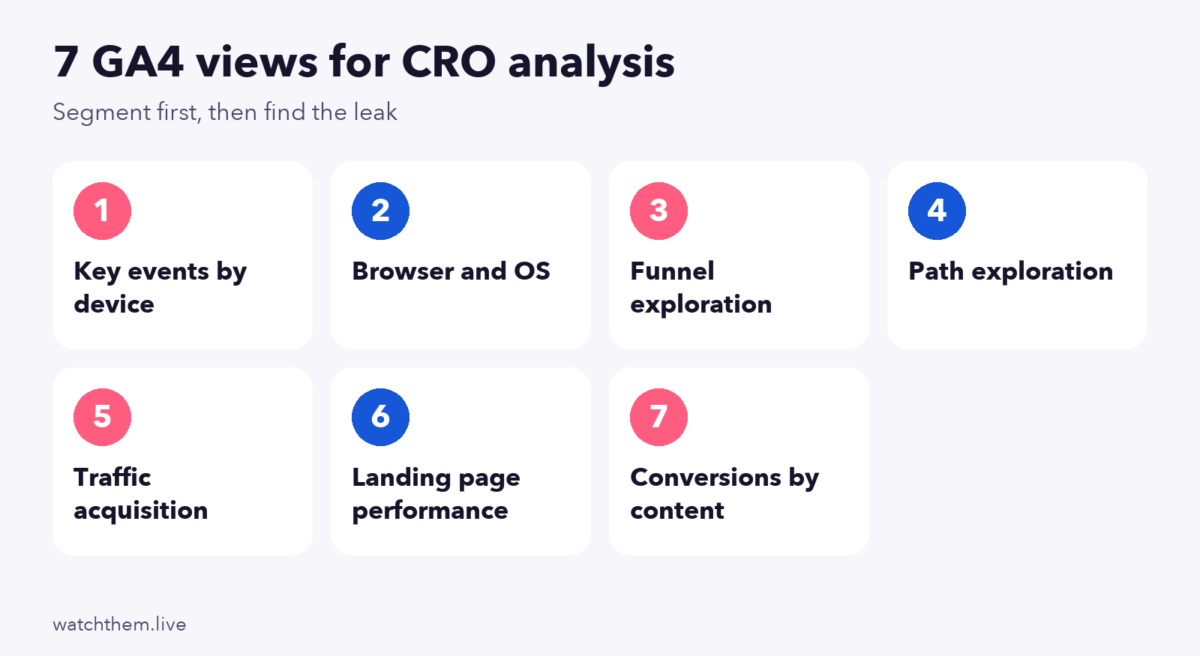
Seven views help most. In GA4, you can build several of them in the Explore section or add comparisons and filters in standard reports. Menu names change, so check your own account.
1. Conversions by Each Device
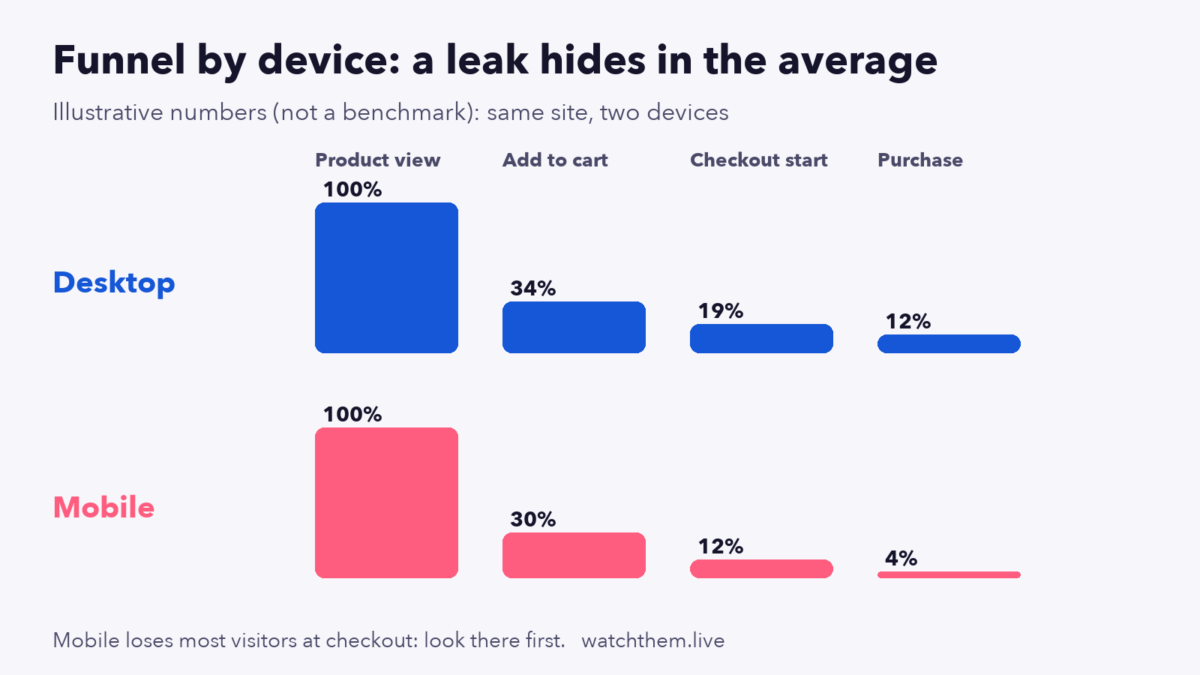
Compare key event rate for desktop, mobile and tablet. Mobile is roughly 60% to 63% of global web traffic, according to Statcounter data for 2025, yet mobile usually converts less than desktop. A large gap suggests mobile usability or speed problems. Watch mobile recordings of the weakest steps, and see mobile CRO.
2. Conversions by Operating System
Differences between systems, such as a low rate on one version, can reveal bugs or layout problems that affect only some devices. Check them before you blame the offer.
3. Conversions by Browser
If one browser converts much worse than the rest, you may have a compatibility issue, such as a form that fails or a script that does not load. Recordings with console error tracking show the cause quickly.
4. Funnel Exploration
Google’s funnel exploration lets you visualize the steps users take to complete a task and see where they fail. You can add a breakdown such as device category to see each step by desktop and mobile. Funnels in GA4 are closed by default, so users must enter at the first step, and a user who skips a step drops out of the later steps. Use it to find the biggest leak, then diagnose it with recordings. The chart below shows how a leak can hide inside an average.
5. Traffic Source
Compare conversion rate and engagement by channel, campaign and medium. A source with high traffic but low conversion may need better targeting or message match. Roundups generally rank referral and email higher and social lower, though exact numbers vary, so treat the ranking as direction, not a target.
6. Traffic and Performance per Landing Page
Review which pages start sessions, and compare their engagement and conversion. A high-traffic landing page with weak results is a good place to test. See landing page metrics and our landing page checklist.
7. Conversions by Content
Find out which articles and pages assist conversions, not just which ones get traffic. Path exploration can show common routes that lead to a key event, and starting from a landing page shows where visitors go next. Use the findings to improve internal links and calls to action. See SEO and CRO.
From Numbers to Action: Add Behavior Data
Analytics tells you where the problem is. To learn why, add behavior analytics:
- Session recordings show what visitors do at the weak step, including errors and hesitation.
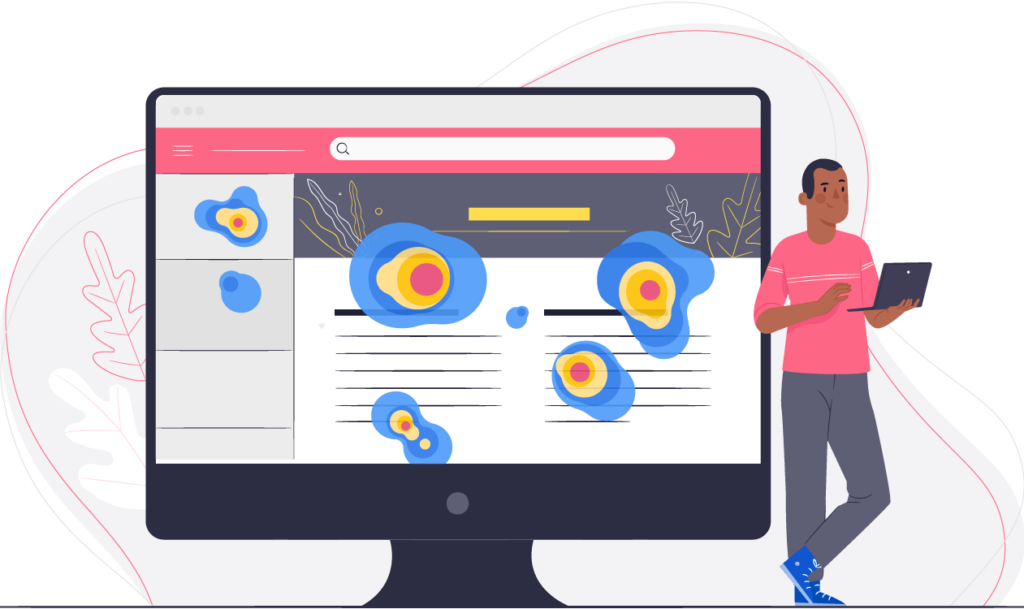
- Heatmaps show clicks and scrolling by device.
- Goal and event tracking and website analytics with filters for device, country and source add speed and clarity.
- Customer behavior analytics and user feedback add context.
Together these let you move from “mobile checkout converts poorly” to “mobile users cannot tap the payment button because it sits under the keyboard.”
A Simple CRO Analytics Routine
- Weekly: check key events, traffic and any big changes by device and source.
- Monthly: review funnels, landing pages and the biggest drop-offs, and pick one problem.
- Diagnose: watch recordings and heatmaps for that step.
- Test: run a test, with a hypothesis and enough traffic. See CRO testing.
- Record: log the result and the lesson.
- Quarterly: review goals, tracking and your roadmap. See how to build a CRO program.
Example: Finding a Mobile Checkout Problem
Suppose overall conversion looks stable, but sales have not grown despite more traffic. A device breakdown shows mobile converting far below desktop. A funnel exploration split by device shows that mobile visitors reach checkout but rarely finish. Recordings of mobile checkout sessions reveal people zooming to tap tiny fields and retyping card numbers after errors. The hypothesis: larger fields, autofill and wallet payments will raise mobile completion. After the change, you compare mobile completion and watch new recordings. Each report played a part: analytics found the leak, the funnel located the step and recordings explained the cause.
Metrics to Segment By
- Device and screen size, because behavior differs on phones and desktops.
- Traffic source and campaign, to see which audiences convert.
- New versus returning visitors, since returning visitors usually need less convincing.
- Country and language, where offers, prices or trust signals differ.
- Landing page and content type, to link pages to results.
Keep segments large enough to be reliable. Slicing data too finely produces patterns that are only noise. Treat segment findings as ideas for follow-up tests, not proof.
Choosing Analytics Tools for CRO
A basic setup has three layers. Web analytics, such as GA4, shows traffic, events and funnels. Behavior analytics, such as session recordings, heatmaps and goal tracking, shows how visitors act. Testing tools run controlled experiments. Google Optimize shut down on September 30, 2023, and GA4 has no built-in A/B testing, so use a third-party tool for tests. When comparing tools, check how they handle consent and privacy, how easy it is to segment by device and source, how quickly reports load and whether data can be exported. See CRO tools for a longer comparison, and our approach to GDPR compliance as an example of what to check.
Common CRO Analytics Mistakes
- Looking only at averages, which hide device and source differences.
- Trusting broken tracking.
- Comparing Universal Analytics and GA4 numbers directly. Definitions, such as bounce rate, differ.
- Drawing conclusions from small samples, or short periods.
- Tracking too many metrics, instead of a few that drive decisions.
- Stopping at the numbers, without learning why visitors behave as they do.
Frequently Asked Questions About CRO Analytics
What analytics do I need for CRO?
A web analytics platform such as GA4 for traffic, events and funnels, plus behavior tools such as session recordings and heatmaps to understand why visitors behave as they do.
Which GA4 reports are most useful for CRO?
Key events by device, funnel explorations, traffic acquisition by source, landing page performance and path explorations are the most useful starting points.
What is a key event in GA4?
It is the new name Google uses for conversions. You mark important events, such as purchases or sign-ups, as key events so GA4 reports them as goals.
How do I find where visitors drop off?
Build a funnel exploration with your key steps, compare steps by device, then watch recordings of the step with the largest loss.
How often should I check CRO analytics?
Review core numbers weekly, run a deeper analysis monthly and review goals and tracking quarterly.
Conclusion
Effective CRO analytics starts with clear goals, a few good KPIs and trustworthy tracking. Then use GA4 to compare devices, browsers, sources, landing pages and funnel steps, find the biggest leak and add recordings and heatmaps to understand the cause. Test one fix at a time, record what you learn and repeat on a regular schedule. Small, data-driven steps beat big guesses.
