
Page Contents
Last updated: October 2026
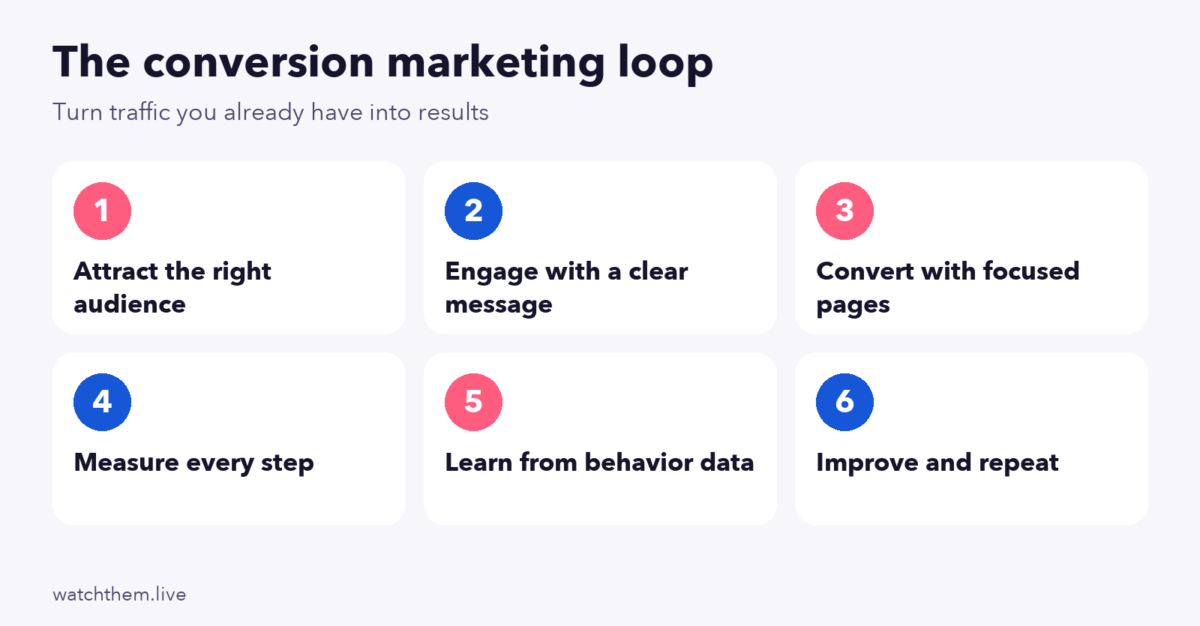
You can succeed at search engine optimization, social media and paid ads and still struggle, because traffic only counts when people act. Conversion marketing is the practice of using marketing and optimization techniques to turn visitors into leads and customers. Instead of asking “How do we get more visitors?”, it asks “How do we get more value from the visitors we already have?”
This guide explains what conversion marketing is, why it matters, how to measure it and nine strategies you can apply in 2026. Where figures come from secondary sources and may vary, we say so.
What Is Conversion Marketing?
Conversion marketing is a set of marketing tactics aimed at getting visitors to complete a goal, such as buying, subscribing, booking a demo or filling in a form. It covers everything from the message in your ad to the design of your landing page, your emails and your checkout.
It overlaps with conversion rate optimization (CRO), but the focus is slightly different. CRO is mainly the testing and improvement process. Conversion marketing is the broader strategy that connects channels, messages and pages so that each step leads naturally to the next. A CRO program is one of its core tools.
Why Is Conversion Marketing Important?
1. It Gets More From Your Existing Traffic
If you pay for traffic that never converts, the money is wasted. Recent benchmark roundups put the average e-commerce conversion rate at roughly 2–3%, which means most visitors leave without buying. Even a small improvement multiplies the return on every channel.
2. It Lowers Cost per Acquisition
When a higher share of visitors convert, each customer costs less to win. That gives you room to compete on ad bids or to invest more in other channels.
3. It Improves Lead Quality
Clear messaging and focused pages attract people who are a good fit and filter out those who are not. See our guide to lead conversion for ways to turn leads into customers.
4. It Shows Where to Focus
Tracking the steps from first click to purchase shows which pages, channels and offers need work, so you can prioritize CRO opportunities with data instead of opinions.
How to Measure Conversion Marketing
Choose a small set of metrics that tie directly to revenue:
- Conversion rate: conversions divided by visitors, multiplied by 100. See what is conversion rate.
- Cost per acquisition (CPA): how much you spend to win one customer or lead.
- Return on ad spend (ROAS): revenue generated for each unit of ad spend.
- Funnel drop-off: where visitors leave between the first visit and the final goal. See funnel optimization.
- Micro conversions: smaller actions, such as video plays or add-to-cart clicks. See micro conversions.
In Google Analytics 4, mark your most important events as key events (the name Google now uses for conversions) and keep the number small so reports stay clear. Make sure ad platforms and analytics count conversions in a consistent way, or your numbers will not match.
9 Conversion Marketing Strategies
1. Optimize Your Landing Pages
Landing pages are where campaigns succeed or fail. Match the headline to the ad, offer one clear action, keep forms short and show proof. Use our landing page checklist and improve results with landing page testing.
2. Design Eye-Catching Calls to Action
Use specific, action-focused button text such as “Get my free quote,” strong contrast with the background and enough size and space to tap easily on mobile. WCAG asks for at least 3:1 contrast for interactive components and 4.5:1 for normal text. Place the main call to action above the fold and repeat it after key sections.
3. Simplify Navigation
Visitors should find what they want in a few clicks. Keep menus short, use clear labels, add search on larger sites and consider removing the main menu on focused landing pages. Our article on website layout has more tips.
4. Use Behavior Analytics
Numbers show where visitors drop off, but not why. Behavior tools fill the gap:
- Session recordings show real visits, including hesitation and errors.
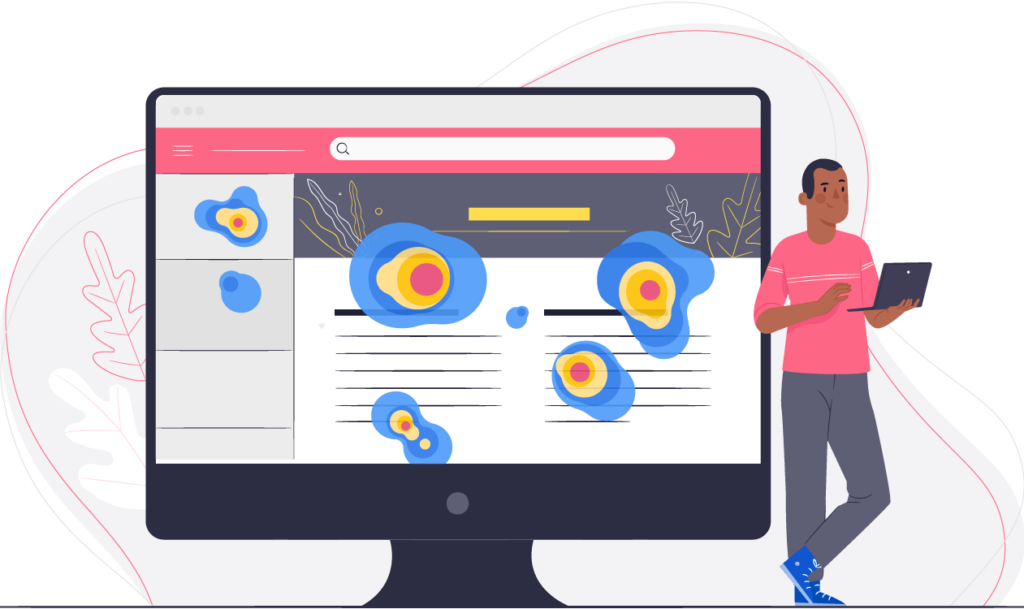
- Heatmaps show where visitors click and how far they scroll.
- Click tracking reveals which buttons and links get attention.
- Customer behavior analytics help you segment visitors by actions.
5. Write a Clear Value Proposition
Within seconds, visitors should know what you offer, who it is for and why it is better than alternatives. Test headlines that focus on the visitor’s outcome instead of your features, and keep the language simple. Remember that plain writing usually converts better: Unbounce’s 2024 benchmark report found pages written at a fifth to seventh grade reading level converted at about 11.1%, against about 7.1% for pages at an eighth or ninth grade level.
6. Speed Up Your Website
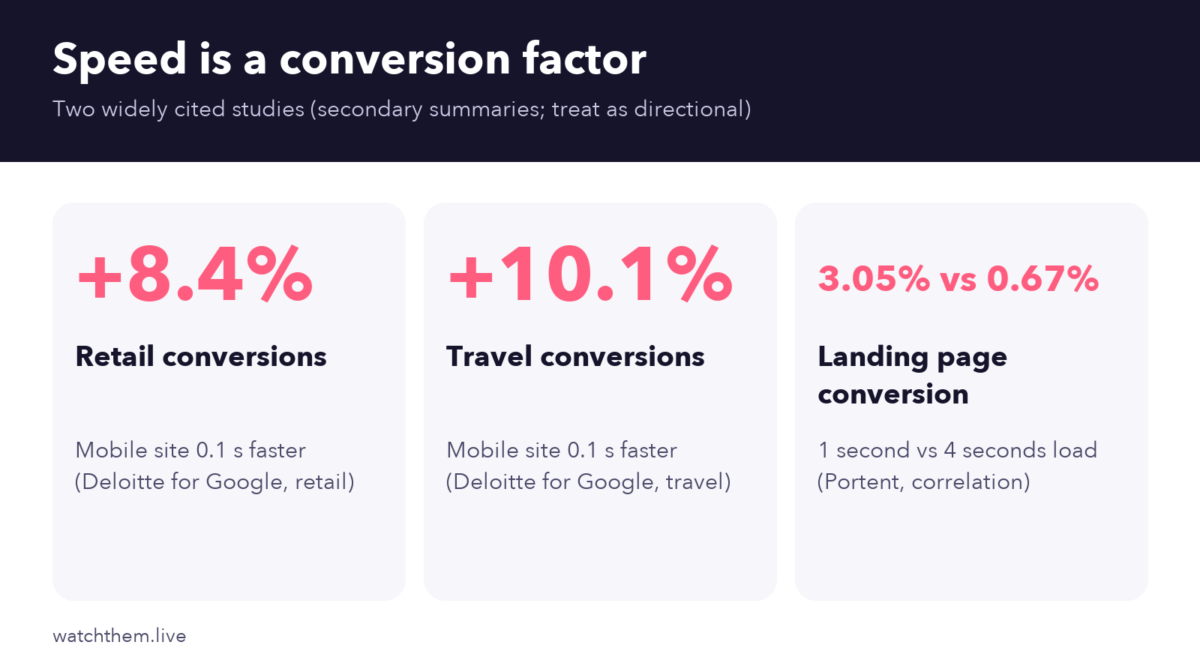
Speed is a conversion factor. A Deloitte study for Google found that making mobile sites 0.1 seconds faster raised conversion rates by about 8.4% for retail and about 10.1% for travel. A Portent analysis of landing pages found much higher conversion for pages that loaded in one second than for those that took four, although that study shows correlation, not proof of cause. Compress images, remove unused scripts, use caching and a CDN and track Core Web Vitals, where Google’s target for Largest Contentful Paint is 2.5 seconds or less.
7. Create High-Quality Content
Useful content attracts the right people and moves them through the funnel. Match content to each stage: guides and articles for awareness, comparisons and case studies for consideration, and demos, trials or offers for decisions. Each piece should end with a relevant next step. Content and conversion work together, as explained in our article on SEO and CRO.
8. Nurture With Email and Retarget Visitors
Most visitors do not convert on the first visit. Capture their email with a useful offer, then follow up with relevant messages. Retargeting ads and abandoned cart emails can bring back people who left without buying. Segment by behavior so each message fits what the person did. Learn more about email marketing. For outbound campaigns to people who have not visited yet, see this comparison of cold email software.
9. Add Social Proof and Test Everything
Reviews, ratings and testimonials reduce doubt. A Spiegel Research Center study found that products with five reviews were about 270% more likely to be purchased than products with none. Then treat every change as a hypothesis. Run A/B tests, wait for reliable results, usually at a 95% confidence level and at least one to two full business cycles, and record what you learn. See conversion rate optimization strategies for a full testing checklist.
Conversion Marketing Across Channels
Keep the message consistent from the first touch to the last:
- Search and content: target intent, not just volume, and send visitors to the page that best answers the query.
- Paid ads: write ad copy that matches the landing page headline and offer.
- Social media: use platforms to build trust and drive people to a clear next step.
- Email: continue the conversation with timely, segmented messages.
- Site and checkout: remove friction, show costs early and offer several payment options. See checkout page design.
A Simple Conversion Marketing Plan to Start With
If you are not sure where to begin, follow this short plan for your first month:
- Week 1: set your main goal and check that conversions are tracked correctly in analytics and your ad platforms.
- Week 2: find your top landing pages by traffic and watch recordings and heatmaps for the pages with the biggest drop-off.
- Week 3: fix the obvious problems, such as slow loading, unclear buttons and long forms, and write two or three test ideas.
- Week 4: launch your first A/B test, set up a basic email follow-up for new leads and schedule a monthly review.
Common Conversion Marketing Mistakes
- Buying more traffic before fixing the site. Extra visitors only multiply the problem.
- Sending all traffic to the home page instead of a page built for the offer.
- Ignoring mobile and speed.
- Measuring only the last click. Look at the whole journey.
- Making changes without testing.
- Chasing quantity over quality, which fills your pipeline with poor-fit leads.
Frequently Asked Questions About Conversion Marketing
What is conversion marketing?
Conversion marketing is the use of marketing and optimization tactics to turn visitors into leads and customers, with a focus on getting more results from existing traffic.
What is the difference between conversion marketing and CRO?
CRO is the process of testing and improving pages to raise conversion rates. Conversion marketing is the wider strategy that aligns channels, messages and pages around conversion goals, and CRO is one of its main methods.
How do you measure conversion marketing success?
Track conversion rate, cost per acquisition, return on ad spend and funnel drop-off, and compare them with your own baseline over time.
What is a good conversion rate?
Benchmarks vary widely. Many e-commerce roundups cite about 2–3%, while landing page medians are higher. Compare against your industry, device and traffic source, as well as your history.
How long does conversion marketing take to work?
Quick fixes can help within weeks. A structured program of research and testing usually shows a clear trend after three to six months.
Conclusion
Conversion marketing turns traffic into results. Start by measuring the whole journey, find the biggest drop-off with recordings and heatmaps, fix one thing at a time and test every change. Align your ads, content, emails and pages around a single clear offer, keep your site fast and trustworthy and keep learning from the data. Over time, steady gains compound into more customers from the same marketing spend.
