
Page Contents
Last updated: October 2026
Getting visitors to your website is only the first step. Real growth comes from lead conversion: turning the people who show interest into paying customers. Many businesses spend heavily on traffic and then lose most of their leads because follow-up is slow, offers are unclear or the path to buying is full of friction. Improving lead conversion is often cheaper and faster than buying more traffic, because you are working with people who have already raised their hands.
This guide explains what lead conversion is, how to calculate it, what benchmarks to expect, and nine proven strategies to improve it in 2026. Where figures come from secondary summaries and vary by source, we say so.
What Is Lead Conversion?
A lead is a person who has shown interest in your business, usually by sharing contact details through a form, a chat, a download or a sign-up. Lead conversion happens when that lead becomes a customer. People often use the term in two ways, so it helps to separate them:
- Visitor-to-lead conversion: the share of website visitors who become leads. This is what most landing pages and forms try to improve. See our guide to conversion rate for the basics.
- Lead-to-customer conversion: the share of leads who eventually buy. This is the figure sales and marketing teams use to judge lead quality and follow-up.
The formula for lead-to-customer conversion rate is simple: divide the number of customers by the number of leads in the same period, and multiply by 100. If 40 of your 1,000 leads buy, your lead conversion rate is 4%. To learn more, see how to calculate conversion rate.
What Is a Good Lead Conversion Rate?
There is no single number, because definitions of “lead” and “conversion” differ between companies and studies. Recent benchmark guides give rough ranges:
- Visitor-to-lead rates are often quoted at about 1% to 3%, with strong pages reaching 8% to 12%.
- Lead-to-customer rates for B2B and SaaS companies are commonly cited at about 2% to 5%. One 2025 industrial-sector study reported an average of about 2.7%, with top performers above 7%.
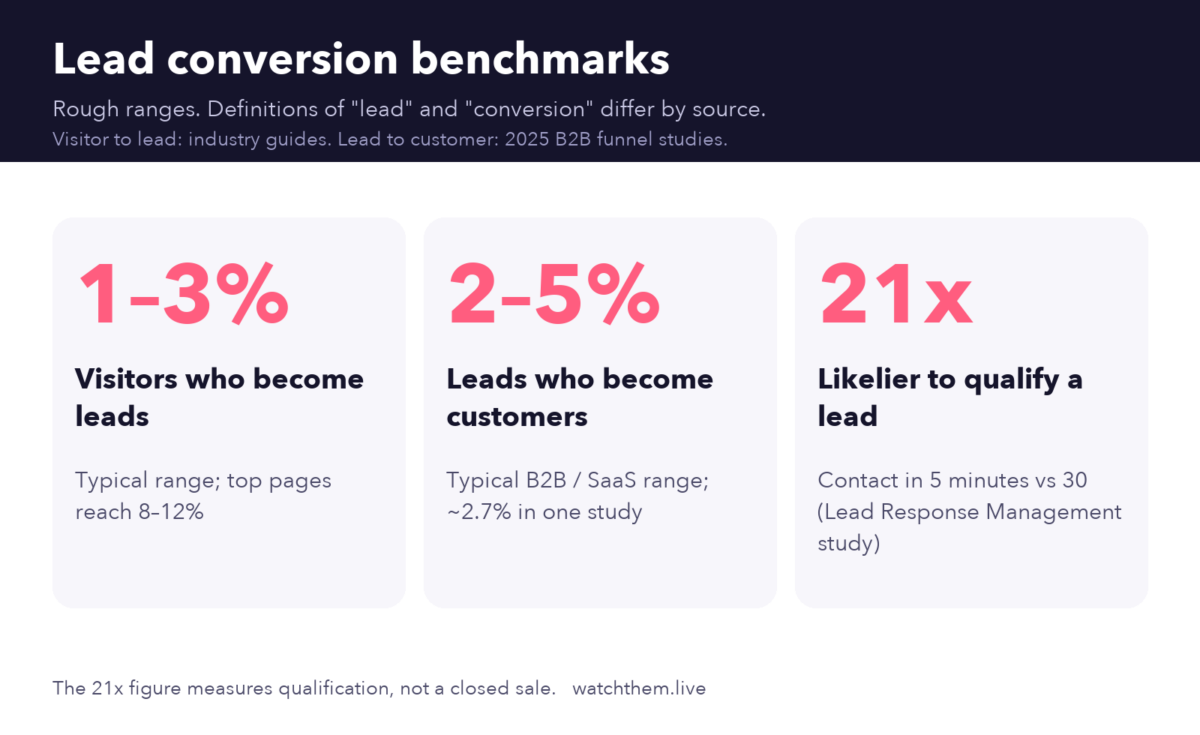
Treat these as direction rather than targets. A lead from a free ebook converts differently from a lead who requested a quote. Compare your numbers with your own history first, and segment by source, offer and device.
The Lead Conversion Process
Having a clear process keeps leads from slipping away. A typical lead conversion process has six steps:
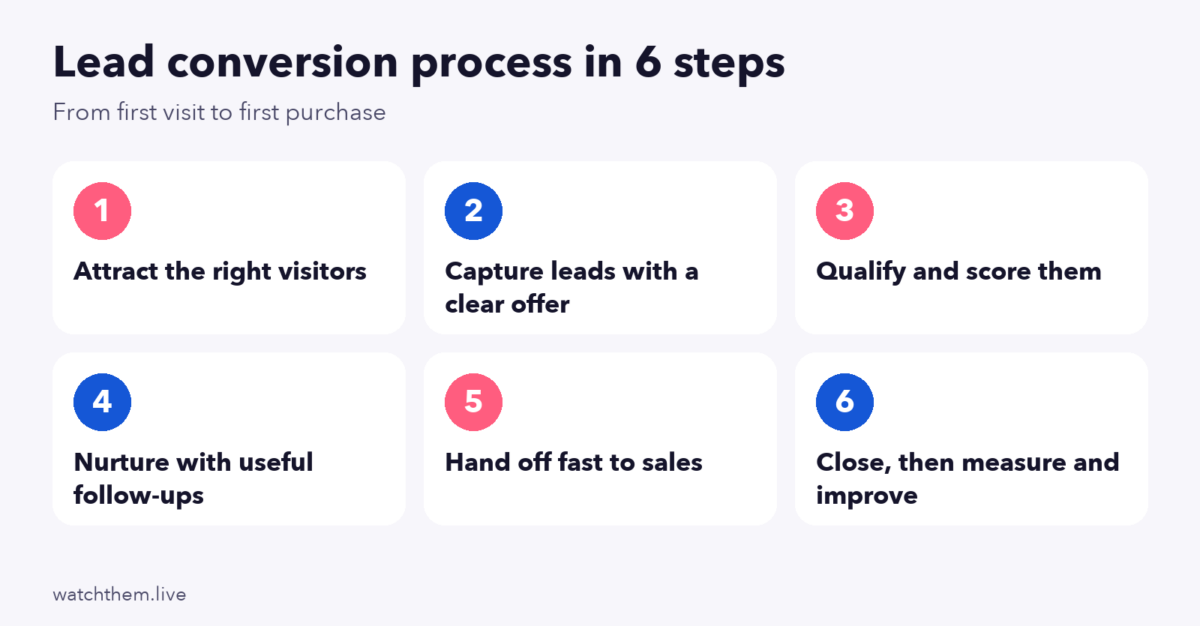
- Attract the right visitors. Use content, search, social media and ads aimed at the people who actually need your product.
- Capture leads. Offer something valuable, such as a guide, a demo or a free trial, in exchange for contact details.
- Qualify and score. Rank leads by fit and behavior so your team knows who to contact first.
- Nurture. Send helpful, timely messages that answer questions and build trust.
- Hand off quickly. Pass hot leads to sales or trigger an automated next step right away.
- Close and learn. Track what turned leads into customers and feed that back into your marketing.
9 Lead Conversion Strategies That Work
1. Respond to Leads Fast
Speed matters. The widely cited Lead Response Management study, which analyzed more than 15,000 web leads, found that contacting a lead within five minutes made it about 21 times more likely to be qualified than waiting 30 minutes. Note that the study measured qualification, not completed sales, and many sites misquote it as “21 times more likely to buy.” The lesson still holds: set up instant auto-replies, route leads to the right person automatically and aim to follow up within minutes, not days.
2. Build Landing Pages That Convert
Your landing page is where most leads are created. Use one clear offer, a headline that matches the ad, social proof and a short form. Review each element with our landing page checklist, then improve it with landing page testing.
3. Make Your Forms Shorter
Every extra field is a reason to quit. Ask only for what you need now, and gather the rest later. HubSpot’s analysis of more than 40,000 landing pages found that multiple text areas and drop-downs lowered conversion the most, and one VWO test showed that removing three form fields increased conversions by 11%.
4. Create Content That Answers Real Questions
Blog posts, guides, comparison pages and case studies attract people who are researching a problem. Match each piece of content to a stage of the buyer’s journey, and add a relevant next step, such as a related guide or a checklist download. Good content also supports your search rankings, which brings in more qualified leads over time.
5. Nurture Leads With Email
Most leads are not ready to buy the day they sign up. Automated email sequences keep you in touch with useful tips, case studies and reminders. Email is also known for strong returns: Litmus’s 2024 State of Email report is widely cited as showing about $36 returned for every $1 spent, though its 2025 survey data shows a spread, with most marketers reporting between roughly $10 and $50. Segment your lists by behavior and interest so messages stay relevant.
6. Add Live Chat
Live chat lets visitors ask a question at the moment of doubt. It works best when your team can see what the visitor was doing. WatchThemLive’s live chat attaches the visitor’s session recording to the conversation, so support understands the problem right away. Learn more about live chat with session recordings.
7. Score and Prioritize Leads
Not every lead deserves the same attention. Give points for fit, such as company size or role, and for behavior, such as visiting the pricing page, watching a demo video or opening several emails. Contact the highest-scoring leads first. If you also do outbound prospecting, this guide to sales prospecting tools compares options for finding and enriching the people you want to reach.
8. Use Social Proof and Remove Doubts
Leads hesitate when they are unsure. Show real testimonials, ratings and case studies near your forms and calls to action, and answer common objections about price, setup and cancellation in an FAQ. Offer guarantees where you can.
9. Track Behavior and Fix the Leaks
The best way to improve lead conversion is to see where leads stall. Combine analytics with behavior tools:
- Session recordings show where visitors hesitate or abandon a form.
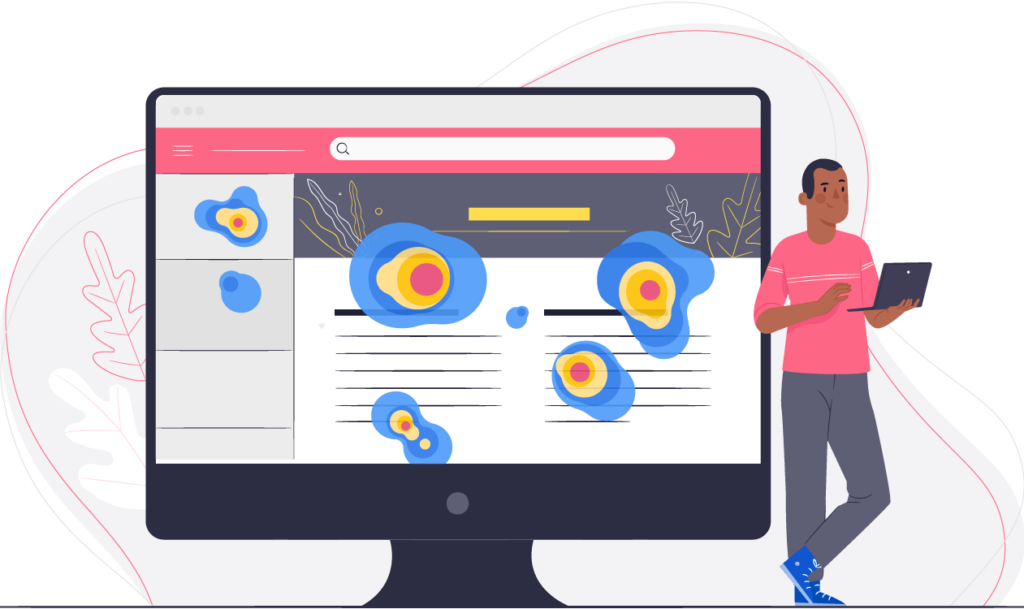
- Heatmaps show which buttons and sections attract attention.
- Goal and event tracking counts form starts, clicks and completions.
- Surveys and user feedback reveal concerns in visitors’ own words.
Study the whole path, not just the form, using funnel optimization and customer behavior analytics.
Metrics to Track
- Visitor-to-lead rate by page, source and device.
- Lead-to-customer rate by source and offer.
- Lead response time and the share of leads contacted within your target.
- Cost per lead and cost per customer.
- Time to convert, from first contact to purchase.
- Lead quality, for example the percentage of leads that become qualified opportunities.
Also track small steps such as form starts and pricing-page visits as micro conversions, because they warn you early when something breaks.
Common Lead Conversion Mistakes
- Slow follow-up. Leads cool down quickly.
- Chasing volume over quality. Many weak leads waste sales time.
- Asking for too much too soon. Long forms lose people.
- Treating all leads the same. Without segmentation and scoring, hot leads wait in line with cold ones.
- Ignoring existing customers. Happy customers refer others and buy again. Read about the value of an existing customer.
- Not measuring. If you cannot see where leads drop off, you cannot fix it.
Frequently Asked Questions About Lead Conversion
What is lead conversion?
Lead conversion is the process by which a person who has shown interest in your business, a lead, becomes a paying customer. It is also used to describe the step when a visitor becomes a lead.
How do you calculate lead conversion rate?
Divide the number of leads who became customers by the total number of leads in the same period, then multiply by 100. For example, 25 customers from 500 leads is a 5% lead conversion rate.
What is a good lead conversion rate?
For B2B and SaaS, many sources suggest about 2% to 5% from lead to customer, but it varies by industry, lead source and sales cycle. Measure against your own baseline first.
How can I improve lead conversion quickly?
Respond within minutes, shorten your forms, add social proof near calls to action and fix the biggest drop-off in your funnel using recordings and heatmaps.
What is the difference between lead generation and lead conversion?
Lead generation is about attracting new leads. Lead conversion is about turning those leads into customers. Both are needed, but improving conversion often gives faster returns.
Conclusion
Strong lead conversion comes from a simple formula: attract the right people, make it easy to share their details, follow up fast, nurture with useful messages and learn from the data. Start by measuring your visitor-to-lead and lead-to-customer rates, find the biggest leak with recordings and heatmaps, and fix one thing at a time. Over a few months, steady improvements can turn the leads you already have into noticeably more customers.
