
Page Contents
Last updated: October 2026
Every business has a funnel, whether or not anyone has drawn it. People discover you, look around, compare, decide and either buy or leave. Funnel optimization is the practice of measuring each step of that journey, finding where people drop off and improving those steps so more of them reach the goal. Because it works on traffic you already have, it is one of the most efficient ways to grow revenue.
This guide explains what a funnel is, which metrics to track, a seven-step method for optimizing it and the best practices and tools for 2026. Where figures come from secondary summaries and vary by source, we say so.
What Is Funnel Optimization?
A marketing or sales funnel describes the stages a person goes through from first learning about you to becoming a customer. Sources use slightly different labels, but most models include:
- Awareness: the visitor discovers your brand through search, social media, ads or referrals.
- Consideration: they explore your pages, read content, compare options or add a product to the cart.
- Decision: they start checkout, request a quote or book a demo.
- Action and retention: they buy, and then come back, refer others or renew.
Funnel optimization means improving the share of people who move from one stage to the next. It is closely linked to funnel analysis, which is how you measure the funnel, and to conversion rate optimization, which is the broader discipline of improving results from your traffic. If you want a simple definition of the structure, read our guide to the conversion funnel.
Why Is Funnel Optimization Important?
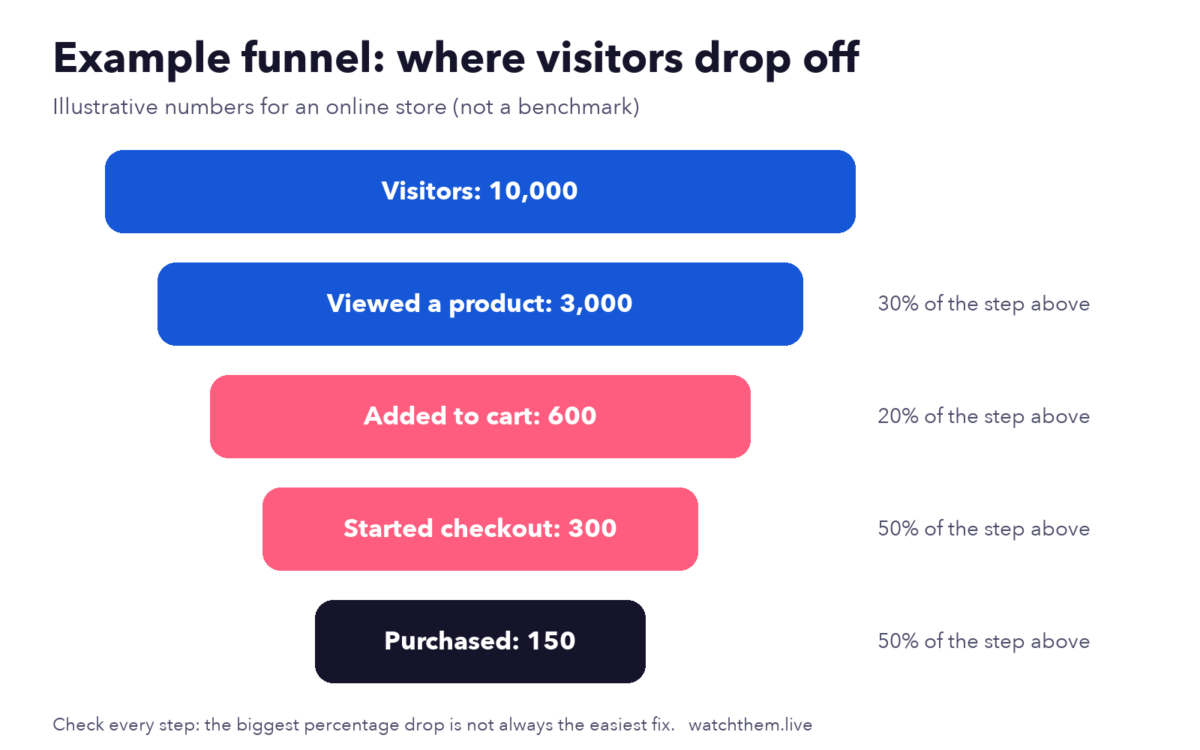
- It shows where money leaks. A single overall conversion rate tells you something is wrong, but not where. A funnel view points to the exact step.
- Small gains compound. Overall conversion is the product of the rates at every step, so a modest lift at each stage multiplies into a much larger result.
- It lowers acquisition cost. If more of your visitors convert, each customer costs less to win.
- It improves the customer experience. Most drop-offs come from friction, confusion or lack of trust, which are problems customers also notice.
Most funnels lose the majority of their visitors. For example, 2025 roundups that cite Baymard Institute research put the average online cart abandonment rate at about 70%, with unexpected extra costs, forced account creation and low trust as leading reasons. Benchmarks vary by source, so use them only as a rough reference.
Best Metrics for Funnel Optimization
Track these numbers for each stage, and review them by device, traffic source and new versus returning visitors:
- Stage conversion rate: the percentage of people who move from one step to the next.
- Drop-off rate: the percentage who leave at each step. Focus on both the percentage and the absolute number of people lost.
- Overall conversion rate: the share of all visitors who reach the final goal.
- Time to convert: how long the journey takes from first visit to purchase.
- Average order value and revenue per visitor.
- Cart and checkout abandonment rate.
- Customer acquisition cost and retention rate.
Our article on funnel metrics goes deeper into each one, and micro conversions such as video plays or button clicks help you spot trouble early.
How Do You Optimize a Sales Funnel? A 7-Step Method
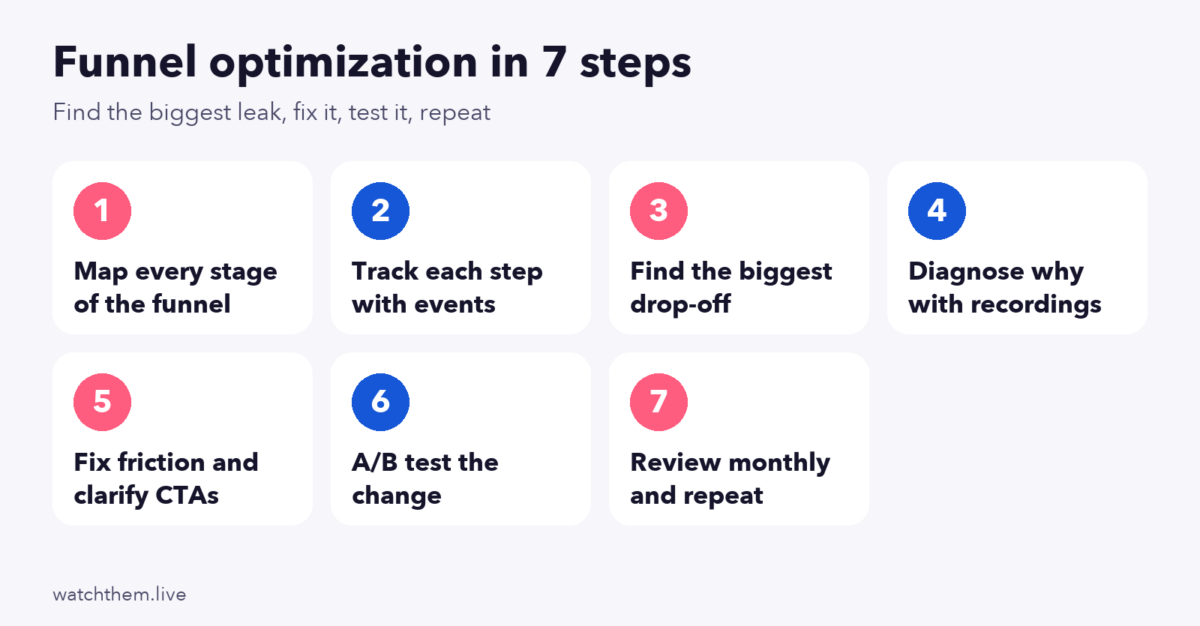
- Map every stage. List each step a visitor takes, from the first page to the final goal, for your main journeys. Separate funnels for different products or traffic sources are often useful.
- Track each step. Set up events or goals for every stage in your analytics, so you can count how many people reach each step.
- Find the biggest leak. Calculate the pass-through rate between each pair of steps. The stage where the most people are lost, in absolute numbers, is usually the best place to start. Segment by device and source to uncover hidden problems.
- Diagnose why. Numbers tell you where, not why. Watch recordings, study heatmaps and ask for feedback to understand what visitors see and feel at that step.
- Fix the friction. Remove distractions, clarify the next step, shorten forms and speed up the page.
- Test the change. Run an A/B test and wait for reliable results before rolling out the winner. See landing page testing for a testing process.
- Repeat. Review the funnel every month, because audiences, campaigns and sites change.
Funnel Optimization Best Practices
1. Test and Improve Your Landing Pages
Landing pages are where many funnels begin. Match the headline to the ad, give one clear call to action and keep forms short. Use the landing page checklist to review every element.
2. Publish Content That Helps at Each Stage
Educational content brings in people at the top of the funnel. Comparison guides, case studies and FAQs help them decide. Match each piece to a stage and include a clear next step, such as a related article or a download.
3. Simplify Navigation
Visitors should always know where they are and what to do next. Use a clear menu, a search box on larger sites and breadcrumb trails so people can move through the funnel without getting lost.
4. Add Social Proof
People trust other customers. A Spiegel Research Center study found that a product with five reviews was about 270% more likely to be purchased than one with none, with the biggest gains from the first few reviews. Show ratings, testimonials and case studies near decision points.
5. Remove Distractions and Use Clear CTAs
Each page should have one main action. Use specific button text, strong contrast and a size that is easy to tap on mobile. Remove links and banners that pull visitors away from the goal.
6. Fix Checkout Friction
The decision stage is where intent turns into revenue. Show total costs early, offer guest checkout, limit form fields and provide several payment options. See our examples of checkout page design.
7. Speed Up and Optimize for Mobile
Slow pages lose visitors at every stage. Google’s Core Web Vitals target a Largest Contentful Paint of 2.5 seconds or less, so compress images, remove unused scripts and check each funnel step on real phones.
8. Keep Testing
Treat every change as a hypothesis, test one thing at a time and record what you learn. Our guide to conversion rate optimization strategies explains how to build a testing habit.
Funnel Optimization Tools
You need two kinds of tools: ones that count what happens and ones that show why.
Analytics and Funnel Reports
Google Analytics 4 lets you define key events and build funnel explorations to see drop-off between steps. Pair it with website analytics and goal and event tracking that you can filter by device, country and traffic source.
Heatmaps
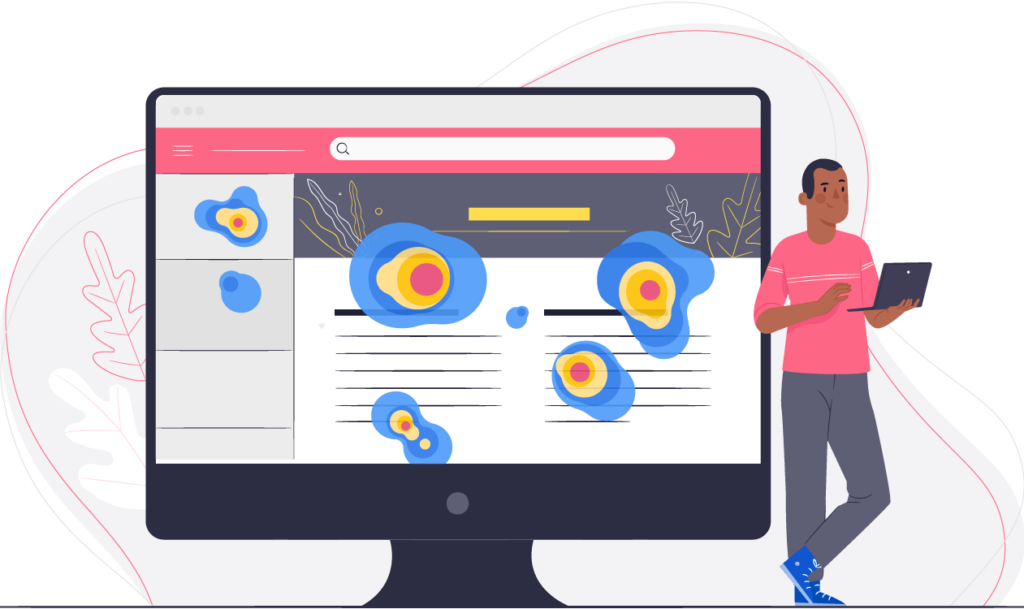
Heatmaps show where visitors click, move and scroll on a page, so you can see whether your call to action gets noticed and where attention stops.
Session Replays
Session recordings let you watch real visits, including rage clicks, hesitation and form abandonment, and catch browser errors that silently break a step.
For more options, compare the tools in our list of CRO tools, and see lead conversion for tactics that work at the middle of the funnel.
Funnel Optimization for Startups
A young company rarely needs a complex funnel. Four stages are enough to start: connect with the right audience through content, search and social media; nurture them with useful emails and resources; convert with a clear offer, trial or demo; and follow up after the sale to earn reviews, repeat purchases and referrals. Measure each stage from day one, even with small numbers, and fix the weakest one first. Do not buy traffic until the stage after the click works.
How to Fix a Leaky Funnel
A leaky funnel loses people between stages. Recognize it by large drops in step conversion rates, high exit rates on one page or leads that never reply. Four fixes cover most leaks:
- Attract the right customers. Poor-fit traffic always leaks. Tighten targeting and match ads to the page.
- Keep prospects engaged. Use email sequences, retargeting and fresh content so interest does not fade.
- Give significant information. Answer questions about price, delivery, security and results before visitors have to ask.
- Make the final step easy. Shorten forms, show total costs and remove distractions from the conversion page.
Common Funnel Optimization Mistakes
- Looking only at the overall conversion rate, which hides where the problem is.
- Fixing the wrong step. The biggest percentage drop is not always the best opportunity. Consider volume and effort.
- Skipping qualitative research. Without recordings and feedback you may fix symptoms rather than causes.
- Changing too much at once, so you cannot tell what worked.
- Ignoring retention. A funnel that ends at the first purchase misses repeat sales and referrals.
- Using benchmarks as targets. They differ by industry, device and definition, so compare against your own baseline first.
Frequently Asked Questions About Funnel Optimization
What is funnel optimization?
Funnel optimization is the process of measuring each stage of the customer journey, finding where people drop off and improving those steps so that more visitors reach your goal.
What are the stages of a funnel?
Most models include awareness, consideration, decision and action, often followed by retention. Different sources use different labels, so adapt the stages to your business.
How do I find the biggest drop-off in my funnel?
Set up tracking for every step, calculate the percentage of people who move from each step to the next and look for the stage where the most people are lost. Then segment by device and source to see whether the problem is concentrated in one group.
How often should I review my funnel?
Check key metrics weekly and do a deeper review monthly or after any major site, pricing or campaign change.
What is a good funnel conversion rate?
It depends on your industry and model. Some 2026 roundups cite end-to-end rates of roughly 1% to 5% for B2B and 5% to 15% for B2C and e-commerce, but definitions vary widely, so use them only as a rough guide.
Conclusion
Funnel optimization turns a vague goal, “get more sales,” into a clear routine: map the stages, measure each step, find the biggest leak, understand the cause, fix it and test the result. Start with analytics to find where visitors drop off, add recordings and heatmaps to learn why, and improve one stage at a time. Over months, steady gains at each step compound into a much higher return from the same traffic.
