
Page Contents
Last updated: October 2026
Most companies treat conversion rate optimization as a series of random tweaks: change a button color this week, rewrite a headline next month. A CRO program replaces that guesswork with a system. It sets goals, collects evidence, ranks ideas, runs tests, records what was learned and repeats the cycle. Teams that work this way improve steadily, instead of relying on a lucky win.
This guide explains what a CRO program is, how to build one in seven steps, how to prioritize test ideas, which tools to use in 2026 and what results to expect. Where figures come from secondary sources and may vary, we say so.
What Is a CRO Program?
A CRO program is an ongoing, structured process for increasing the share of your visitors who complete a valuable action, such as buying, signing up or requesting a quote. It combines analytics, user research, testing and a regular review rhythm. If you are new to the topic, start with our complete guide to conversion rate optimization.
The basic measure is the conversion rate: conversions divided by visitors, multiplied by 100. For instance, 250 orders from 10,000 visitors is a 2.5% conversion rate. Recent benchmark roundups put the average e-commerce conversion rate at roughly 2–3%, though it varies by industry and device. See how to calculate conversion rate if you need the formula in detail.
What Is a CRO Roadmap?
A CRO roadmap is a plan, usually for the next three to six months, that lists which pages and journeys you will work on, which hypotheses you will test and who is responsible. A good roadmap has three layers:
- Goals: the business outcomes you want to improve, for example “raise checkout completion from 45% to 50%.”
- Themes: the areas where research shows the biggest problems, such as mobile checkout or pricing-page clarity.
- Experiments: the specific tests, with a hypothesis, a main metric and an estimated duration.
The roadmap should be flexible. When a test shows something surprising, you will want to change priorities.
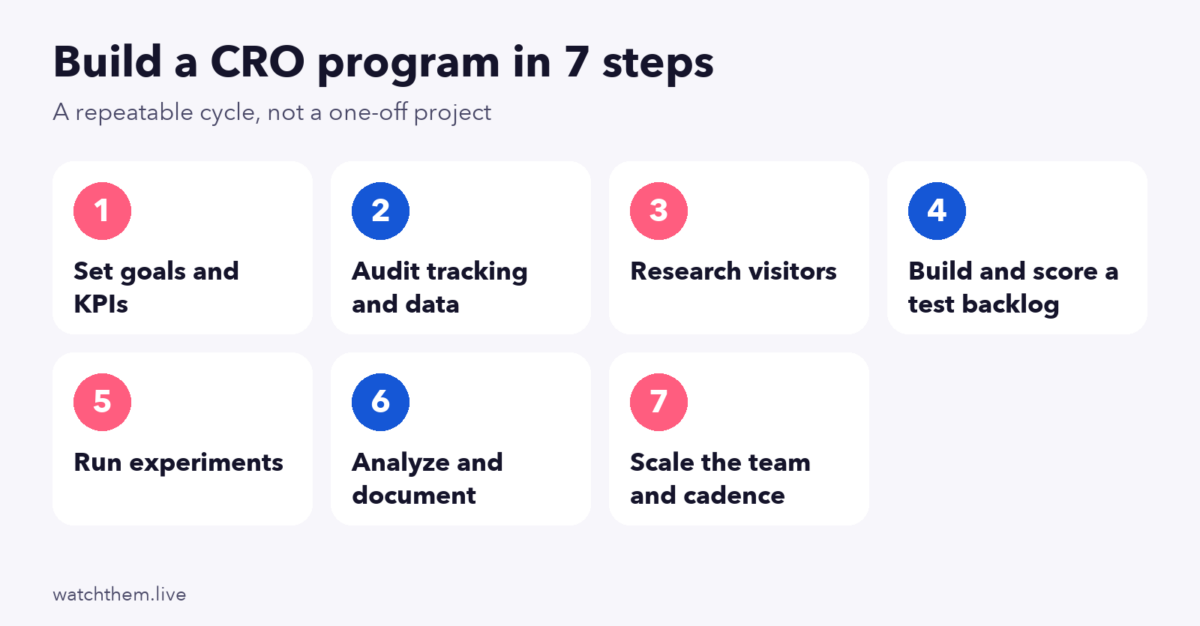
How Do You Build a CRO Program? 7 Steps
1. Set Clear Goals and KPIs
Decide what success looks like. Pick one primary metric, such as purchases or qualified leads, and a few supporting metrics, such as add-to-cart rate, average order value and revenue per visitor. Write down your current baseline and a realistic target. Our guide to website performance metrics can help you choose.
2. Audit Your Tracking and Data
A program built on bad data wastes time. Check that your analytics counts conversions correctly, that events fire on every key step and that internal traffic is excluded. In Google Analytics 4, mark your most important events as key events, and track smaller steps as micro conversions. A quick CRO audit shows what is missing.
3. Research Your Visitors
Good tests come from good research. Combine numbers with observation:
- What brings visitors in? Review traffic sources, search terms and campaigns to see which audiences matter most.
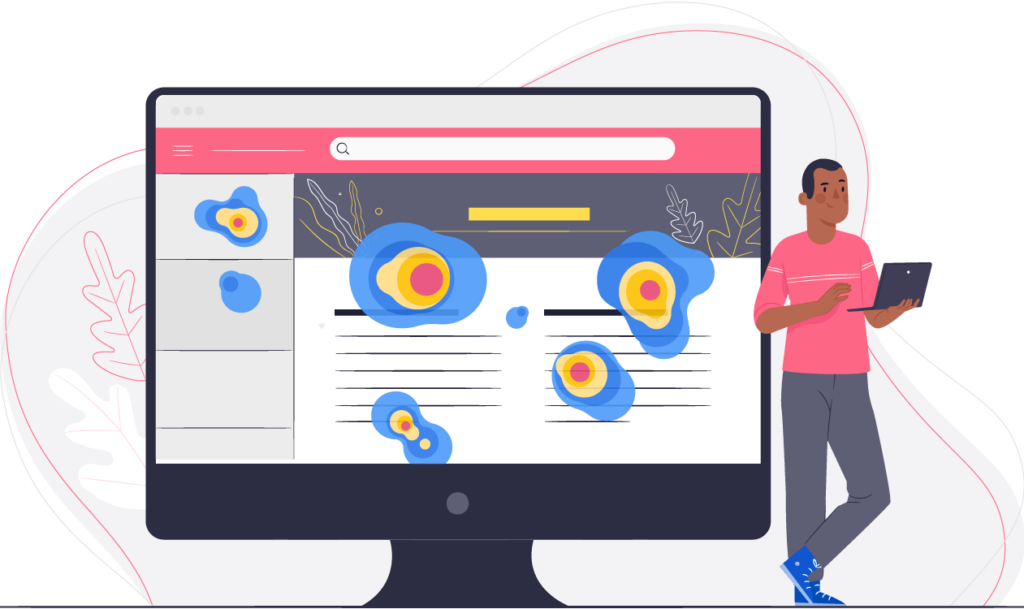
- What stops them from converting? Study drop-off in your funnel, then watch session recordings and look at heatmaps for the pages where people leave.
- What persuades them to act? Use surveys and user feedback to learn what visitors want to know before buying, and map their path with a buyer journey map.

4. Build and Prioritize a Test Backlog
Turn your findings into hypotheses written as “If we change X, then Y will happen, because Z.” Then rank them so you test the most promising ideas first. Two popular scoring methods are:
- ICE: Impact, Confidence and Ease, each scored from 1 to 10 and combined into one number.
- PIE: Potential, Importance and Ease. PIE was created by Chris Goward of Conversion to prioritize which pages to test.
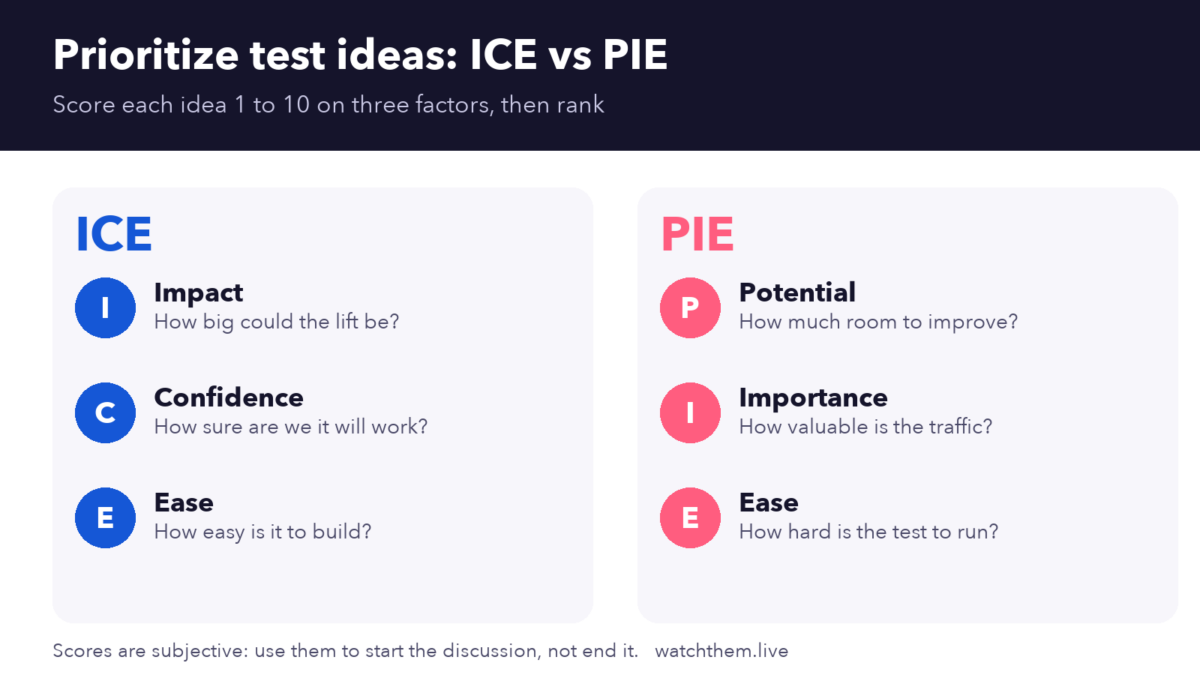
Both methods are quick, but critics note that scores are subjective, and some teams use more detailed scoring with mostly yes-or-no questions, such as CXL’s PXL framework. Use scoring to guide the conversation, not to replace judgment.
5. Run Experiments
Test one meaningful change at a time. Split traffic randomly, define your main metric before you start and plan the sample size and duration. Most sources recommend running a test for at least one to two full business cycles, often two weeks, and waiting for a 95% confidence level before choosing a winner. Do not stop early because early results look good. Our guide to CRO testing and landing page testing explains the process in detail.
6. Analyze and Document Every Result
Look beyond the headline number. Check results by device, traffic source and new versus returning visitors. Write down the hypothesis, the result and what you learned, including the tests that lose. A shared test log prevents repeated mistakes and shows new team members what works for your audience.
7. Scale the Team and the Cadence
As the program matures, aim for a steady rhythm: a weekly check of key metrics, a monthly review of results and a quarterly update of the roadmap. A small team can start with a part-time owner, an analyst or marketer, and a designer or developer. Larger programs add a researcher and a dedicated experimentation lead. If you do not have the capacity, compare options in our guide to CRO agencies and plan your conversion rate optimization budget.
Best CRO Tactics to Include in Your Program
- Improve page speed. Google’s Core Web Vitals aim for a Largest Contentful Paint of 2.5 seconds or less, and a Deloitte study for Google found that a 0.1-second mobile speed improvement lifted retail conversion by about 8.4%.
- Design for mobile first. Check tap targets, forms and pop-ups on real phones.
- Simplify forms and checkout. Remove unnecessary fields, show total costs early and offer guest checkout. See shopping cart design.
- Add social proof. A Spiegel Research Center study found that products with five reviews were about 270% more likely to be bought than products with none.
- Test calls to action. Use specific text, strong contrast and one main action per page.
- Refresh high-performing content. Update your best-ranking pages, because they already attract visitors.
- Use retargeting and email to bring back visitors who did not convert the first time.
CRO Program Tools
A typical stack has three layers:
- Analytics: Google Analytics 4 or a similar platform to measure traffic, events and funnels. Add simple website analytics with filters for device and traffic source.
- Behavior tools: session recordings, heatmaps and goal and event tracking to see why visitors act the way they do.
- Experimentation tools: a platform to run A/B tests. Google Optimize was shut down on September 30, 2023, and GA4 has no built-in testing, so you need a third-party tool. Google named Optimizely, AB Tasty and VWO as its initial GA4 integration partners, and many others exist.
Compare more options in our list of CRO tools.
What Results Should You Expect?
Be realistic. Not every test wins. A 2014 VWO survey of its customers found that about one in seven A/B tests produced a winner, while other analyses report higher shares of significant results, depending on how a “win” is defined. The point is that learning, not only winning, is the goal: a test that disproves a guess still saves you from a bad change. Over a few months, a well-run program usually shows a clear upward trend, and the knowledge compounds as your test log grows.
Common CRO Program Mistakes
- Testing without research. Random ideas rarely beat evidence-based ones.
- Stopping tests too early. Early swings are often noise.
- Testing tiny changes on low traffic. You will not reach a reliable result.
- Not documenting. Knowledge disappears when people leave.
- Focusing only on the final conversion. Track the steps that lead to it, too.
- Expecting instant results. CRO is a long-term habit.
Frequently Asked Questions About CRO Programs
What is a CRO program?
It is a structured, ongoing process for improving conversion rates using research, prioritized hypotheses, controlled tests and documented learning.
How do I start a CRO program from scratch?
Set a goal and baseline, check your tracking, research where visitors drop off and why, build a ranked list of test ideas and run your first experiment on the highest-impact page.
How long does it take to see results from CRO?
Quick fixes can help within weeks. A structured testing program usually needs three to six months to show a clear trend.
How many tests should I run each month?
It depends on traffic and resources. Many small teams run one to two meaningful tests a month, while larger teams run several at once on different pages.
Do I need a CRO agency?
Not at the start. Many teams begin with analytics and behavior tools, then add an agency or specialist when they need more testing capacity.
Conclusion
A CRO program turns optimization from guesswork into a repeatable habit. Set clear goals, trust your data, research why visitors leave, rank your ideas, test one change at a time and write down every lesson. Keep the cycle going, and your site gets a little better every month.
