
Page Contents
Last updated: October 2026
Imagine you have invested heavily in search, social media and ads. Traffic grows month after month, but most visitors leave without doing anything. Something is not working, and more traffic will not fix it. This is where CRO marketing proves its value. Conversion rate optimization applies research and testing so that a bigger share of your existing visitors take the actions you want, such as buying, signing up or asking for a quote.
This guide makes the business case for CRO marketing: what it is, how the process works, the benefits and the math behind them, and how to improve results on your most important pages. Where figures come from secondary sources, we say so.
What Is the Importance of CRO Marketing?
Most websites convert only a small share of their traffic. Recent benchmark roundups put the average e-commerce conversion rate at roughly 2–3%, which means that for every 100 visitors, about 97 leave without buying. Every visitor costs something, whether in ad spend, content work or time, so a better conversion rate lets you earn more from every unit you already spend.
CRO marketing matters because it works at the point where marketing money turns into results. Traffic channels bring people to the door. CRO decides how many walk in. For the full background, see our complete guide to conversion rate optimization, and read how it connects to conversion marketing.
The Math Behind CRO Marketing
A simple example shows why small improvements matter. Suppose a store gets 10,000 visitors, spends $4,000 on ads and has an average order value of $60. At a 2% conversion rate, it gets 200 orders and $12,000 in revenue, a cost of $20 per order. Raise the conversion rate to 2.5%, and the same traffic gives 250 orders and $15,000 in revenue, and the cost per order falls to $16. That is 25% more sales from the same visitors, with no extra ad spend.
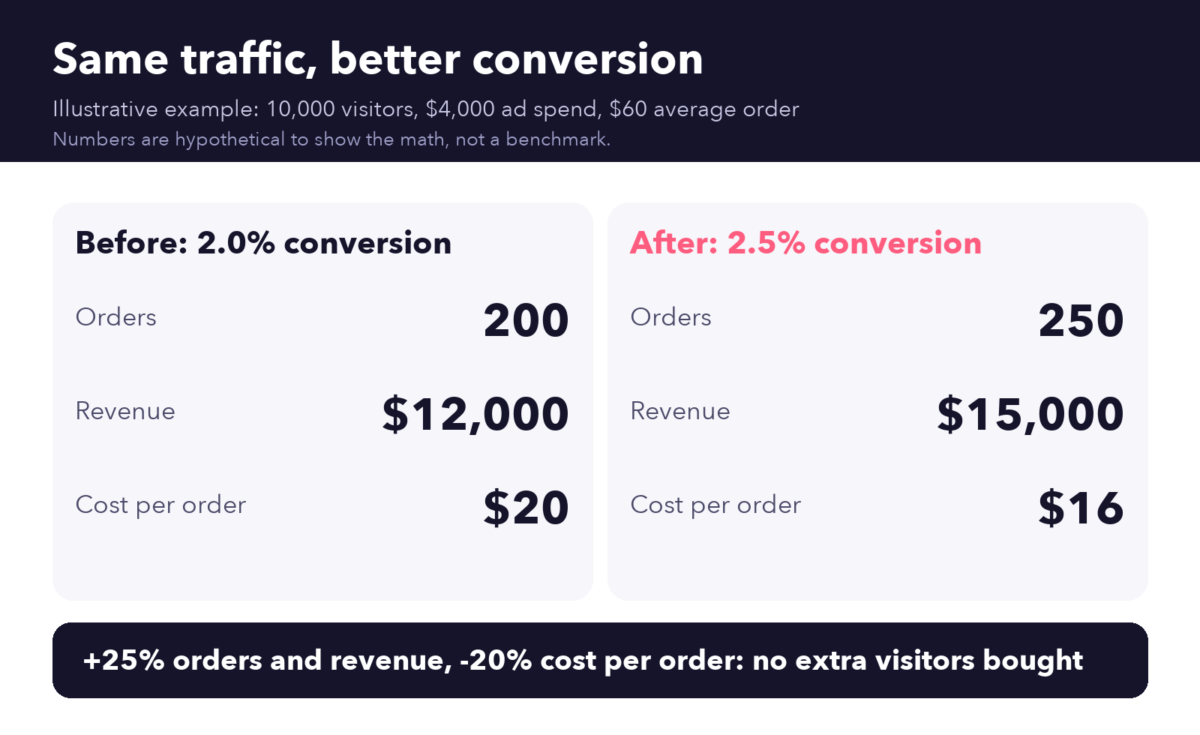
The numbers above are illustrative, not a benchmark. But the logic is real: conversion gains apply to all future traffic, while paid traffic only delivers while you keep paying. Agencies and vendors often claim large returns on CRO spending, but those claims come from their own models rather than independent surveys, so judge CRO by your own test results and margins, and check whether any ROI figure is based on revenue or profit.
What Is the CRO Marketing Process?
CRO is a repeatable cycle, not a one-time project. For a detailed plan, see how to build a CRO program.
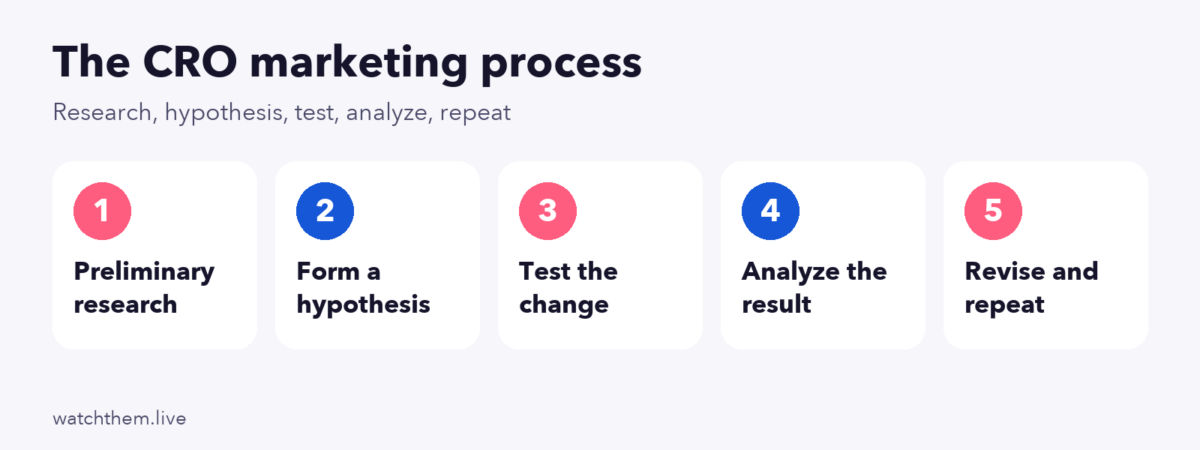
1. Preliminary Research
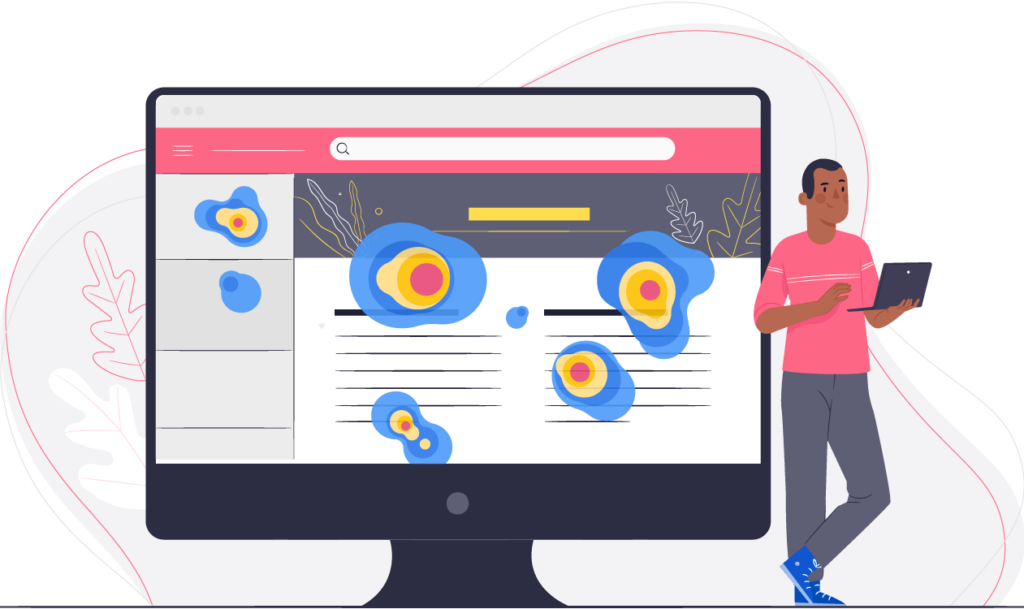
Start with evidence. Review analytics to see where visitors drop off, then use session recordings, heatmaps and surveys to understand why. Study your audience with persona mapping and a buyer journey map.
2. Hypothesis
Turn what you learned into a testable idea: “If we change X, then Y will happen, because Z.” A hypothesis keeps tests focused and teaches you something even when it fails.
3. Test the Change
Run an A/B test, with traffic split randomly between the original and the variation. Plan the sample size and duration in advance, and aim for at least one to two full business cycles. See landing page testing.
4. Analyze the Result
Wait for a reliable result, usually at a 95% confidence level, then look at segments such as device and traffic source. Record what you learned, including losing tests.
5. Revision and Repeat
Roll out the winner, then use the insight to plan the next test. Not every test wins: a 2014 VWO survey of its customers reported that about one in seven A/B tests produced a winner, while other analyses report higher shares depending on how a win is defined. The value comes from steady learning.
Benefits of CRO Marketing
1. A Rise in Profits
Higher conversion rates mean more revenue from the same traffic, and often a lower cost per acquisition. Because the extra sales come without extra media cost, the effect on profit can be larger than the effect on revenue.
2. More Customers and Leads
Improving the path from visit to sale brings in more customers or leads. Faster response to leads helps, too: the Lead Response Management study found that contacting a web lead within five minutes made it about 21 times more likely to be qualified than waiting 30 minutes. See lead conversion.
3. CRO Marketing and Traffic
CRO is not only about conversions. Many of its improvements, such as faster pages, clearer content and better mobile layouts, also support search visibility. Google’s Core Web Vitals aim for a Largest Contentful Paint of 2.5 seconds or less, and a Deloitte study for Google found that a 0.1-second mobile speed gain lifted retail conversion by about 8.4%. See SEO and CRO for how the two work together.
4. Staying Ahead of Competitors
When competitors fight over the same keywords and audiences, the company that converts better can afford to bid more, offer more value or invest in growth. A strong testing habit is also hard to copy, because it builds knowledge about your own customers that others do not have.
5. Better Customer Experience
Most conversion problems are usability problems: confusing forms, unclear offers and slow pages. Fixing them makes visitors’ lives easier, which helps loyalty and reviews. See CRO and UX.
More Reasons CRO Marketing Pays Off
- Lower ad costs. A page that converts better can win more at the same bid, and it often improves quality signals in ad platforms.
- Higher customer lifetime value. Better experiences, clear onboarding and follow-up lead to repeat purchases.
- Insights nobody can copy. Competitors can copy a design but not the knowledge you build about your own customers through tests.
- Problem pages become visible. Funnel and checkout data show exactly which pages lose people.
- A stronger brand. Clear, fast and honest pages make a business look professional.
How to Improve CRO Marketing
1. Get to Know Your Audience
Learn who visits, what they want and what holds them back. Use analytics, recordings and feedback, and segment by device, traffic source and new versus returning visitors. Different groups need different messages. Our guide to website personalization shows how to tailor the experience.
2. Create a Better Home Page
The home page is often the first stop. State clearly what you do and who you serve, show your main paths, use one clear call to action and include proof such as reviews and logos. A Spiegel Research Center study found that products with five reviews were about 270% more likely to be purchased than products with none.
3. Improve the Pricing Page
Pricing pages are high-intent. Make plans easy to compare, highlight the recommended option, answer common objections and show costs clearly, including fees. Hidden costs are a leading reason for abandoned carts: roundups that cite Baymard Institute research put average cart abandonment near 70%.
4. Inform and Educate Your Customers
Educational content builds trust and helps people decide. Publish guides, comparisons and FAQs, and place clear next steps in each. Check your landing pages against our landing page checklist.
5. Track the Right Numbers
Measure conversion rate overall and by page, device and source. Add micro conversions such as button clicks and form starts. See how to calculate conversion rate and website metrics.
CRO Marketing for Different Business Types
The process is the same everywhere, but the focus changes with the business model:
- Online stores: product pages, cart and checkout carry the most revenue. Work on images, reviews, shipping clarity and guest checkout, and track add-to-cart rate and cart abandonment.
- B2B and lead generation: landing pages, forms and follow-up speed matter most. Track cost per qualified lead, not only form fills.
- SaaS: the sign-up flow, pricing page and first-use experience drive growth. Measure trial sign-ups, activation and paid conversion.
- Content and media sites: newsletter sign-ups, return visits and engagement on key articles are the main goals.
- Local and service businesses: click-to-call, contact forms and booking pages are the conversions to protect, especially on mobile.
Start with the page type closest to revenue, fix its biggest problem, and expand from there.
Common CRO Marketing Mistakes
- Testing without research, which produces random changes.
- Buying more traffic before fixing the site, which multiplies the leak.
- Stopping tests early, when early swings look like wins.
- Chasing tiny tweaks on low traffic, where results cannot be reliable.
- Ignoring lead quality, so conversions rise but sales do not.
- Not documenting results, so lessons are lost.
Not sure where to begin? Run a quick CRO audit, or review your options in our guide to CRO agencies and CRO tools.
Frequently Asked Questions About CRO Marketing
What is CRO marketing?
CRO marketing is the use of research, testing and design improvements to increase the percentage of website visitors who complete a desired action.
Why is CRO marketing important?
It increases the return on your existing traffic. A higher conversion rate means more customers or leads from the same spend, and often a lower cost per acquisition.
How is CRO different from SEO?
SEO brings more visitors from search engines. CRO makes more of the visitors you already have take action. They work best together.
How long does CRO take to show results?
Quick fixes can help within weeks, while a testing program usually needs three to six months to show a clear trend.
Do I need a large budget for CRO?
No. You can start with analytics, recordings, heatmaps and simple tests, and add specialists or agencies later as your program grows.
Conclusion
CRO marketing is a winning strategy because it improves the efficiency of everything else you do. Start with research, form clear hypotheses, test one change at a time and keep learning. Focus on your home page, pricing page and landing pages, track the right numbers and be patient. Over time, small gains in conversion add up to more customers, lower costs and a stronger business.
