
Page Contents
Last updated: October 2026
Conversion rate optimization changes as quickly as the technology, devices and expectations around it. Tactics that worked a few years ago, such as a pop-up on every page, can now hurt. New ones, such as AI-assisted analysis, are appearing in tools every month. This guide covers the ten conversion rate optimization trends that matter in 2026, what each one means in practice and how to test it without chasing every shiny idea.
One warning before we start: a trend is only worth following if it helps your visitors on your site. Treat everything below as a hypothesis to test, not a rule. Where figures come from secondary reports and vary, we say so.
Why Do CRO Trends Matter?
Customer expectations rise when other sites get better. Visitors compare your page with the fastest, clearest experience they have had anywhere, not with your direct competitors. Following trends helps you spot what is becoming normal, such as mobile-first design or transparent pricing, before the gap shows up in your numbers. It also helps you avoid wasting time on tactics that are fading. The core of conversion rate optimization stays the same: research, hypothesis, test, learn.
Top 10 Conversion Rate Optimization Trends for 2026
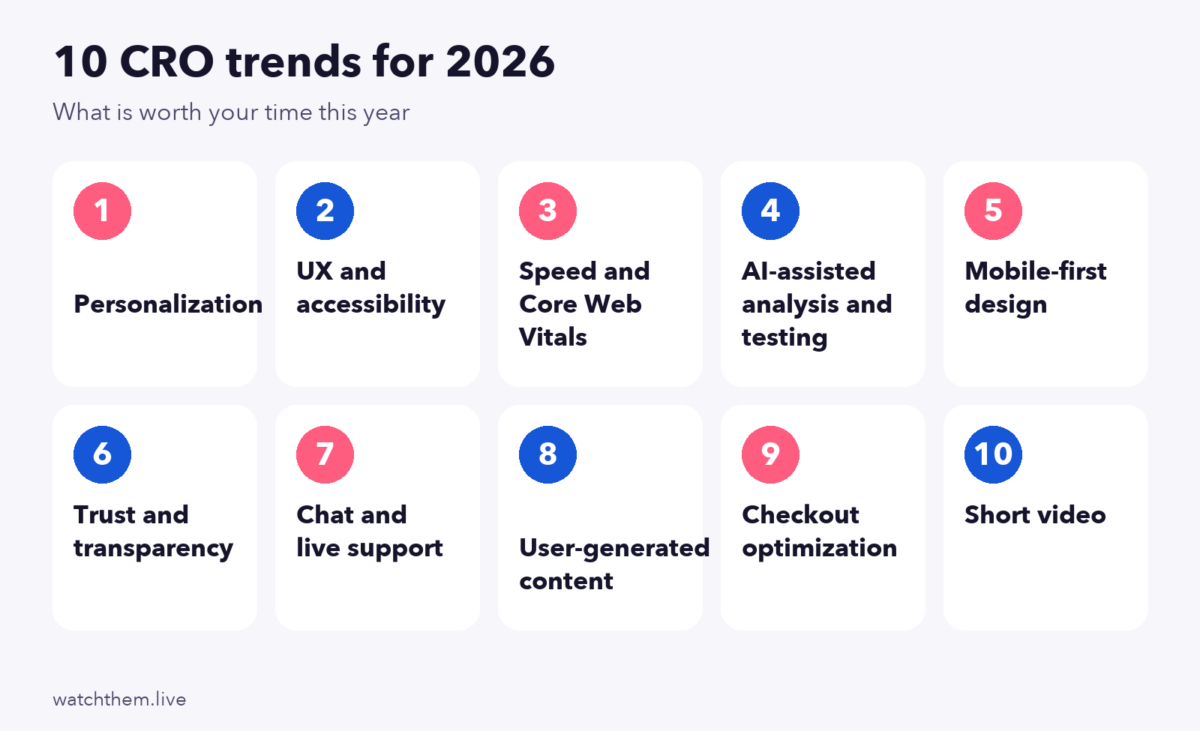
1. Personalization
Generic pages are losing ground to experiences that fit the visitor. Personalization can be simple: different headlines for new and returning visitors, product recommendations based on browsing, or landing pages matched to the ad that brought the visitor. A 2021 McKinsey survey reported that about 71% of consumers expected personalized interactions and about 76% were frustrated when they did not get them. The data is dated, but the direction has held. Start small, segment by behavior and source, and respect privacy. See website personalization and CRO personalization.
2. User Experience and Accessibility
Good UX is now a baseline, and accessibility is part of it. Make navigation clear, forms simple and pages readable. The Web Content Accessibility Guidelines ask for a text contrast ratio of at least 4.5:1 for normal text, and WCAG 2.2 sets a minimum touch target of 24 by 24 CSS pixels. Accessible design widens your audience and usually improves usability for everyone. Track it with UX metrics and see CRO and UX.
3. Speed and Core Web Vitals
Speed remains one of the most reliable levers. Google’s Core Web Vitals target a Largest Contentful Paint of 2.5 seconds or less, an Interaction to Next Paint of 200 milliseconds or less and a Cumulative Layout Shift of 0.1 or less, measured at the 75th percentile of page loads. INP replaced First Input Delay as a Core Web Vital on March 12, 2024, so responsiveness to clicks and taps now matters as much as loading. A Deloitte study for Google found that a 0.1-second mobile speed gain lifted retail conversion by about 8.4%. See website application optimization for practical steps.
4. AI-Assisted Analysis and Testing
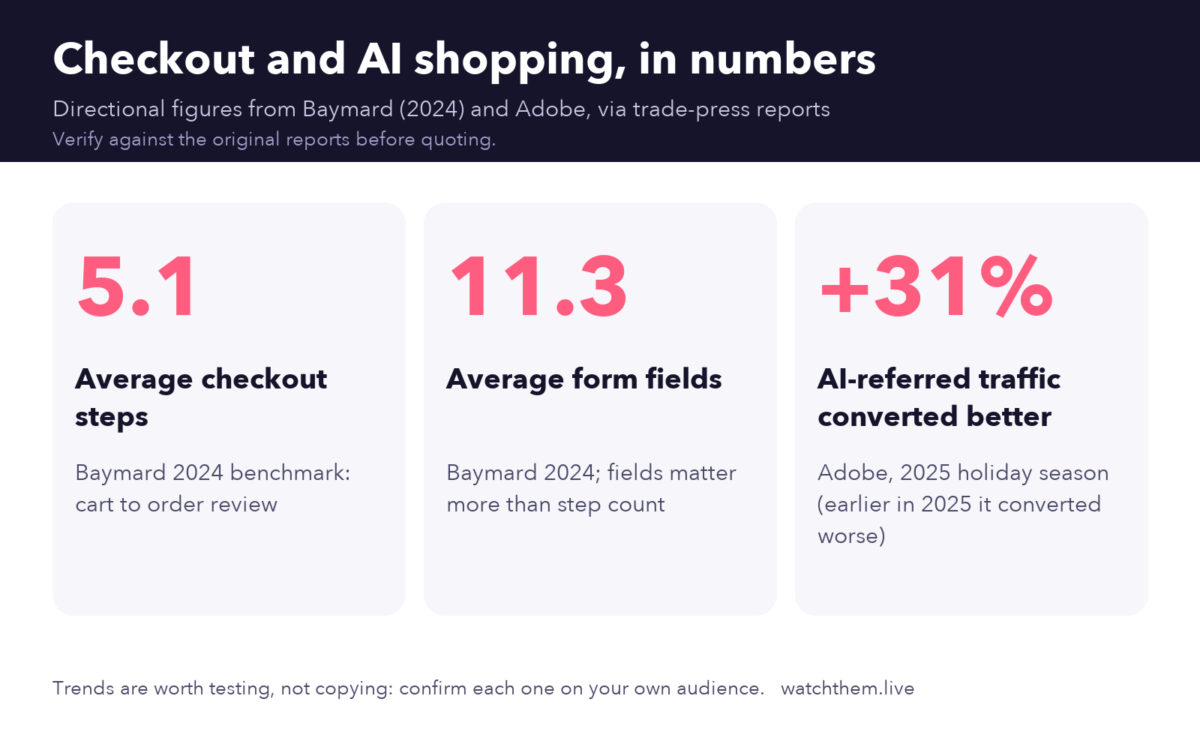
AI is moving into analytics, session review, copy suggestions and test planning. Used well, it saves time: it can summarize recordings, spot patterns in feedback and propose hypotheses. Used badly, it produces generic copy and false confidence. Treat AI output as a draft or a lead to verify, keep a human in charge of decisions and test every AI-written change against the original. Shopping is changing, too: Adobe reported that visitors arriving from generative AI sources converted worse than other traffic in early 2025 but better by the 2025 holiday season, according to trade press summaries. Check the original reports before relying on specific figures.
5. Mobile-First Design
Statcounter data for 2025 put mobile at roughly 60% to 63% of global web traffic, yet mobile visitors usually convert less than desktop visitors. Design the small screen first: one column, large tap targets, short forms, autofill, digital wallets and no pop-ups that cover the content. Review recordings of mobile sessions regularly. See mobile CRO.
6. Trust and Transparency
Visitors are more careful about what they share and whom they trust. Be clear about prices, fees, delivery times, returns and how you use data. Roundups that cite Baymard Institute research put average cart abandonment near 70%, with unexpected costs, forced account creation and low trust among the top reasons. Show security signals at payment, plain-language policies and real contact details. Privacy is part of trust: read about our GDPR compliance as an example of what to document.
7. Chat and Live Support
Live chat and chatbots answer questions at the moment of doubt. They work best when they hand over to a human quickly and when the agent can see what the visitor was doing. Use chatbots for simple questions and routing, not to block people from help. Measure chat’s effect on conversion and satisfaction, and avoid pop-ups that interrupt checkout.
8. Social Proof and User-Generated Content
Reviews, photos and videos from real customers are more convincing than brand claims. A Spiegel Research Center study found that products with five reviews were about 270% more likely to be purchased than products with none, and that purchase likelihood tends to peak at average ratings of about 4.0 to 4.7 stars, because perfect scores can look less believable. Collect reviews after purchase, show them near decisions and moderate them honestly.
9. Checkout Optimization
Checkout is where most revenue leaks. Baymard’s 2024 benchmark reported an average checkout flow of about 5.1 steps and about 11.3 form fields, and it argues that the number of fields matters more than the number of steps. Remove fields you do not need, offer guest checkout and several payment methods, show total costs early and make errors easy to fix. See checkout page design and shopping cart design.
10. Short Video
Short product or explainer videos can answer questions faster than text, but they also add weight to the page. Test whether video improves conversions for your audience before you roll it out, load it on demand and add captions. Do not let autoplaying video slow down the main content.
How to Evaluate a CRO Trend
- Ask what problem it solves. Tie each trend to a problem in your data, such as a drop-off in checkout or poor mobile engagement.
- Check the evidence. Look for original research, and be careful with vendor claims and old statistics.
- Estimate the effort and impact, and rank ideas using a simple score. See how to build a CRO program.
- Run a test. Use A/B tests or before-and-after comparisons, and wait for reliable results. See landing page testing.
- Watch real behavior. Session recordings and heatmaps show whether the change helps or confuses visitors.
- Keep or drop it, and record the result.


How to Build a Trend-Ready CRO Plan
You do not need to adopt every trend at once. A simple plan keeps you focused:
- Review your data first. Find your three biggest leaks, such as slow mobile pages, a weak checkout step or low-trust pricing pages. Choose trends that address them.
- Fix the foundations. Speed, mobile layout, clear pricing and working tracking give every other idea a better chance. Trends such as personalization and AI work badly on a slow, confusing site.
- Test one trend per quarter. Give each idea enough traffic and time, and avoid running overlapping tests on the same page.
- Keep a trend log. Record what you tried, the result and whether to repeat it, so the team builds a playbook for your own audience.
- Revisit regularly. Check your numbers each month and review the plan each quarter, since results and audiences change.
The aim is to learn faster than your competitors, not to copy them. A modest test on a real problem beats a large project built on a headline.
Trends That Are Fading
- Aggressive pop-ups that cover the content on mobile.
- Fake urgency, such as countdown timers that reset, which damage trust and may break the law.
- Forced account creation before checkout.
- Carousels that hide key messages, which most visitors never see.
- Keyword-stuffed pages written for search engines, not people.
Frequently Asked Questions About CRO Trends
What are the biggest CRO trends in 2026?
Personalization, faster and more responsive pages, mobile-first design, AI-assisted analysis, trust and transparency, simpler checkout and authentic social proof are the most important.
Should I follow every CRO trend?
No. Choose trends that address real problems in your data, then test them on your own audience before rolling them out.
How is AI changing conversion rate optimization?
AI helps with analysis, summarizing recordings and generating ideas, but it still needs human judgment and testing. It also changes how shoppers find products.
What is INP and why does it matter?
Interaction to Next Paint measures how quickly a page responds to clicks and taps. It became a Core Web Vital in March 2024, replacing First Input Delay, and a good score is 200 milliseconds or less.
How do I know if a trend works for my site?
Run a controlled test or compare periods carefully, track conversion and secondary metrics and watch real sessions to see how visitors react.
Conclusion
The most useful CRO trends in 2026 are not flashy: faster pages, clearer mobile experiences, honest pricing, simpler checkout, relevant personalization and careful use of AI. Pick the one that fixes your biggest leak, test it and learn from the result. Keep research and measurement at the center, and trends become tools instead of distractions.
