

Page Contents

Last updated: November 2026
CRO best practices are repeatable habits that raise the share of visitors who complete a goal, but the phrase hides a trap: a “best practice” is only a proven starting point for your own tests, not a guaranteed win. Practitioners who write about the topic keep returning to the same point, that guidelines such as short forms or bright buttons work in some contexts and fail in others, so every idea should be treated as a hypothesis until your own data confirms it.
Instead of a flat list, this guide organizes the practices into the four stages of an optimization loop (research, prioritize, test, learn), then covers the on-page tactics that most often make it into a test plan, the myths that waste budget and a table of what to check before you trust any result.
What CRO Best Practices Are, and What They Are Not
Conversion rate optimization is the systematic process of increasing the percentage of visitors who take a desired action. A best practice is a pattern that has worked often enough to be worth testing first. It is not a rule, and it is not the same as copying a competitor.
- Guidelines, not laws. Use them to generate ideas and shortcuts for obvious problems such as a broken button.
- More than A/B testing. Research, analytics, user feedback, copy and design all belong to the work. Testing only verifies the result.
- A process, not a project. Learning compounds only when tests, notes and decisions repeat.
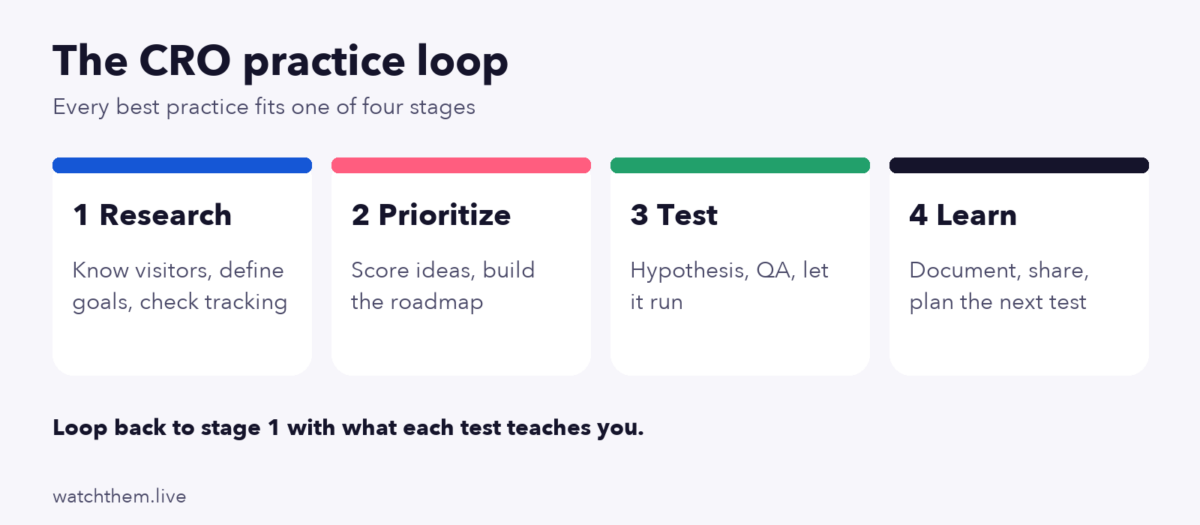
Stage 1: Research Practices
1. Know your visitors and find the leaks
Start by learning who arrives, what they want and where they leave. Combine analytics by segment with qualitative evidence. Website heatmaps and scroll maps show where attention goes, recordings show where people struggle and short surveys explain why. A structured review such as the CRO audit process and checklist keeps this stage from becoming guesswork.
2. Define goals and write specific hypotheses
Without a clear goal you cannot tell whether a change worked, and without a hypothesis you do not know what you are testing or how to read the result. Use one sentence: “Because we saw A, we believe B will cause C, which we will measure with D.” Decide the primary metric before launch, and treat others as guardrails.
3. Check that tracking works
Every goal, event and variation should be verified in your testing and analytics tools before traffic is sent. A tag that fires twice or not at all will quietly invalidate weeks of work.
4. Measure micro conversions
Macro goals such as purchases are rare, so tests on them take long. Micro conversions, for example product views, add-to-cart clicks or form starts, give earlier signals and show where the journey breaks. Use them to diagnose, but make decisions on the primary goal.
5. Do not trust opinion, including your own
The loudest person in the room, the highest-paid opinion and personal taste are poor evidence. A short evidence log, with data, a screenshot or a customer quote for each idea, ends most debates.
6. Do not copy competitors blindly
A rival’s layout may have been built for different traffic, a different margin or a different brand promise, and you cannot see whether it works for them. Use competitors for inspiration and then validate with your own audience.
Stage 2: Prioritization Practices
7. Build a ranked roadmap
List ideas in one place and score each for impact, confidence and effort, or use a framework such as PIE or ICE. Quick wins, such as fixing a broken form, go straight into the backlog; bigger bets get tests. A roadmap protects the team from random requests. See how to build a CRO program for a working setup.
8. Fix obvious problems without a test
Broken links, errors, unreadable text and slow images do not need an experiment. Testing is for choices where you honestly do not know the answer.
Stage 3: Testing Practices
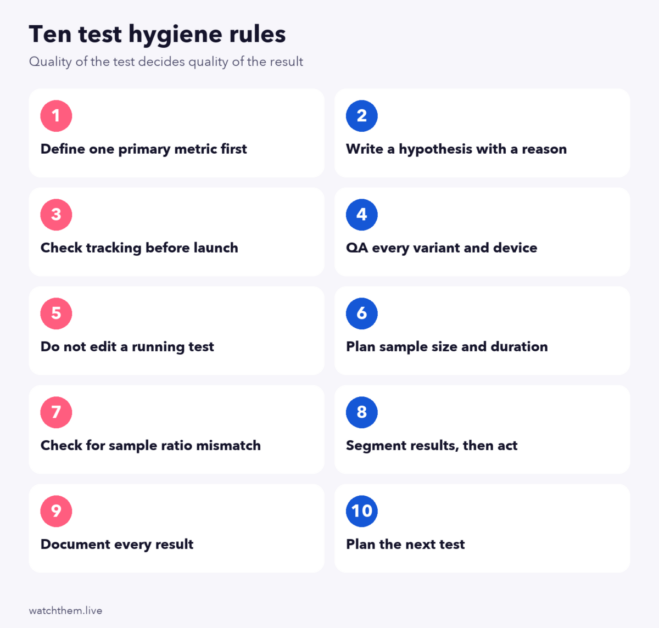
9. QA every variation
Check each variation on the main browsers and devices before launch. Flicker, layout shifts and broken buttons on one device can quietly bias results.
10. Do not change a running test
Editing traffic split, goals or design mid-test breaks the comparison. If something is wrong, stop the test, fix it and restart.
11. Be patient and let the test finish
Decide sample size and duration up front. Run at least one to two full business cycles so weekday and weekend behavior are both covered, and resist stopping the moment a variation looks ahead, because early peeking raises false positives. Check for a sample ratio mismatch: if a 50/50 split delivers visibly uneven groups, the setup has a bug.
12. Segment the results, then decide
A flat overall result can hide a winner on mobile and a loser on desktop. Review by device, source and new versus returning visitors, but treat deep slices carefully because small groups mislead.
13. Know what A/B testing cannot do
Low-traffic sites cannot reach significance for small changes. For those, bigger changes, sequential improvements and qualitative research are better than tests that never conclude. The article on common landing page testing mistakes lists the traps.
Stage 4: Learning Practices
14. Document every test
Record the hypothesis, screenshots, dates, sample, result, confidence and what you learned, including the losses. A searchable log prevents repeating failed ideas and turns individual tests into knowledge.
15. Zoom out and plan the next test
Ask what the result says about the audience and use it to create follow-up tests. Winning ideas often apply to other pages, and losing ideas often point to the real problem.
16. Choose tools that fit your stage
You need analytics, a way to see behavior, a way to collect feedback and a testing tool. Complexity should match your traffic and team, and none of the tools replaces a good hypothesis.
On-Page Tactics Worth Testing First
The following ideas appear in most CRO guides. Use them to feed the test backlog.
| Tactic | Why it often helps | What to test | Where it fails |
|---|---|---|---|
| Faster pages | Less waiting, fewer exits | Image weight, script load, LCP element | Little impact if the page was already fast |
| Clear call to action | Removes doubt about the next step | Specific text, contrast, position | Wording that overpromises |
| Shorter forms and checkout | Less effort at the decision | Number of fields, guest checkout, wallets | Lower lead quality |
| Social proof | Reduces perceived risk | Reviews near the button, logos, numbers | Old or generic testimonials |
| Mobile-first layouts | Most traffic comes from phones | Sticky button, tap size, input types | Hiding key content |
| Simple navigation | Keeps attention on the goal | Menu size, search placement | Users who need to explore |
| Message match | Confirms the click was right | Ad headline versus page headline | Overpromising in the ad |
| Privacy and transparency | Builds trust before sharing data | Clear consent text, no dark patterns | Intrusive banners that block content |
For deeper lists, see landing page ideas to test and mobile conversion rate optimization tips. Speed targets are documented in the web.dev Core Web Vitals thresholds: LCP 2.5 seconds or less, INP 200 milliseconds or less and CLS 0.1 or less at the 75th percentile.
How Best Practices Change by Business Model
| Business | Practices that usually come first | Practices that usually come later |
|---|---|---|
| E-commerce | Product page clarity, delivery and return information, checkout friction, mobile payment | Recommendations, bundles, loyalty prompts |
| Software and subscriptions | Clear value on the home page, short sign-up, activation steps | Pricing page tests, in-app prompts |
| Lead generation | Form length, offer clarity, response speed, proof | Lead scoring and routing changes |
| Content publishers | Page speed, readable layout, relevant calls to action | Personalized recommendations |
A Simple Scoring Example for Prioritizing Tests
Score each idea from 1 to 10 for impact (how many visitors and how strongly), confidence (how good the evidence is) and ease (how fast it is to build), then average them. The ICE score below shows how the ranking works with invented ideas.
| Idea | Impact | Confidence | Ease | Average |
|---|---|---|---|---|
| Show delivery cost on the product page | 8 | 9 | 8 | 8.3 |
| Remove two optional form fields | 7 | 8 | 9 | 8.0 |
| Rewrite the home page headline | 6 | 5 | 8 | 6.3 |
| Rebuild the whole checkout | 9 | 5 | 2 | 5.3 |
The score is a conversation tool, not a law. Its real benefit is making assumptions visible so the team can challenge them with data.
Building a Testing Rhythm in Your Team
- Weekly: review running tests, check data quality and move the next idea into build.
- Monthly: share a short results note, including losses and what they taught.
- Quarterly: refresh research, re-score the roadmap and retire ideas that no longer fit.
- Roles: someone owns the roadmap, someone builds, someone checks data, and one person decides when a test ends. In a small team one person can wear several hats, but the decisions should still be separate.
A regular rhythm matters more than the number of tests. Two clean tests a month with careful notes teach more than a dozen rushed ones.
Myths That Waste Testing Budget
| Myth | Reality |
|---|---|
| “CRO means changing button colors.” | Colors rarely move the needle on their own. Offers, clarity, trust and friction usually matter more. |
| “Every test must win.” | Many tests do not. A clean loss or a flat result still teaches you something. |
| “A 95% result means it is certain.” | It means the observed difference would be unlikely by chance under the test assumptions. Bad setup still breaks it. |
| “Best practices work everywhere.” | They are starting points that depend on audience and context. |
| “CRO is a one-off project.” | Audiences, devices and competitors change, so the loop has to continue. |
| “More traffic fixes a low rate.” | It multiplies the same leaks. Fix the page first. |
Learning From CRO Practitioners
Many well-known practitioners shaped current practice, each from a different angle. Bryan Eisenberg is known for work on persuasion and call-to-action design, Oli Gardner for landing page design and the Unbounce platform, Scott Brinker for the marketing technology landscape, Brian Massey for the scientific approach at Conversion Sciences and Joanna Wiebe for conversion copywriting at Copyhackers. Reading across them shows the same pattern: research first, one clear message, evidence over opinion and constant testing. Use their ideas as hypotheses, and check them against your own data.
A Short Pre-Launch Checklist for Any Test
- Is there a written hypothesis with a reason?
- Is one primary metric chosen, with guardrails?
- Has tracking been verified on every variation?
- Has every variation passed QA on main devices?
- Are sample size and duration planned?
- Does the team agree not to change the test while it runs?
The fuller conversion rate optimization checklist for 2026 applies the same ideas to whole pages.

Frequently Asked Questions About CRO Best Practices
What are the most important CRO best practices?
Research your visitors, define goals and hypotheses, prioritize ideas, test with clean methods, and document what you learn.
Are CRO best practices guaranteed to work?
No. They are starting points that have worked often, and results depend on audience, offer and context, so validate each one with a test.
Is CRO the same as A/B testing?
No. A/B testing is one method. CRO also includes analytics, user research, copywriting, design and prioritization.
How long should I run a CRO test?
Until the planned sample size is reached and for at least one to two full business cycles, regardless of early results.
Can small websites do CRO?
Yes, but with less testing and more research. Use recordings, surveys and larger changes if traffic is too low for reliable tests.
How often should I review my CRO practices?
Review results after each test, and revisit the whole roadmap every quarter or after big changes in traffic, product or design.
Conclusion
The best CRO practices form a loop: research the visitor, rank ideas, test with discipline and record what you learn. Tactics such as faster pages, clear calls to action and shorter forms are good candidates, but each one is a hypothesis for your own audience. Avoid the common myths, protect your tests from changes and mistakes, and let documented evidence, not opinions, guide the next experiment.
