
Page Contents
Last updated: November 2026
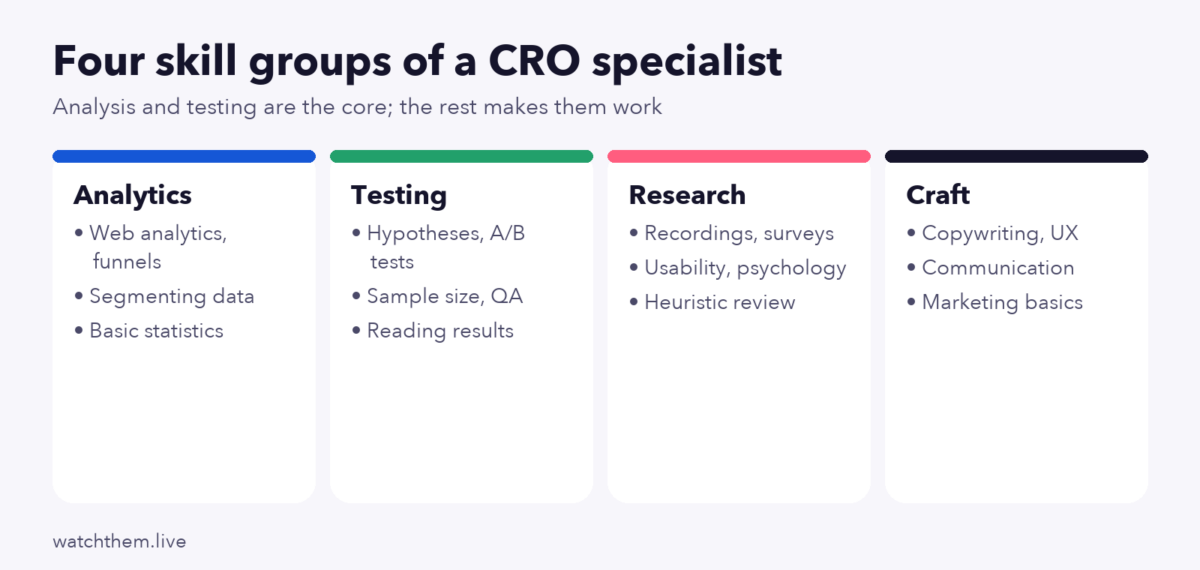
CRO skills are the mix of analytics, experimentation, research, persuasion and communication that lets a person raise the share of visitors who take a valuable action. No single talent is enough: someone who loves data but cannot explain findings gets ignored, and someone with great design taste but no testing discipline mostly ships opinions. This guide breaks the role into concrete skills, shows how to rate yourself, and gives a six-month plan for building the ones you lack.
What a CRO Specialist Actually Does All Week
Job postings for conversion rate optimization specialists tend to describe the same loop: study data and user behavior, form a hypothesis, test it, interpret the result and report it to people who make decisions. Requirements listed in postings usually combine analytics, A/B testing tools, research and psychology, marketing knowledge and communication. Postings differ on years of experience (roughly two to four years appears in examples), so treat those numbers as examples, not an industry standard.
Seeing the week helps you see the skills. A typical week might include checking that tracking is accurate on Monday, reviewing a funnel report and a handful of session recordings on Tuesday, writing hypotheses and a test plan on Wednesday, quality-checking a variant on Thursday and presenting last month’s results on Friday. Each of those tasks calls on a different skill, which is why the rest of this guide is organized by task, not by personality trait.
The Skills Scorecard: Rate Yourself 1 to 5
Use this table before reading further. Score each row honestly, then look at your lowest two scores: they are your learning priorities.
| Skill | What “good” looks like | Quick self-test |
|---|---|---|
| Web analytics | You can build a funnel, segment by device and source, and spot a tracking error | Can you explain why two reports show different conversion numbers? |
| Experiment design | You write a hypothesis with a reason, one primary metric and a stopping rule | Can you say how long a test must run before you start it? |
| Basic statistics | You understand sample size, significance, and why peeking inflates false positives | Can you explain a confidence interval to a manager? |
| User research | You mix quantitative data with recordings, surveys and interviews | When did you last watch 20 sessions in a row? |
| Persuasive writing | Headlines and calls to action state a clear benefit and next step | Can you rewrite a vague headline in three versions? |
| UX and visual hierarchy | You can tell what the eye sees first and why | Can you point to the primary action on a page in two seconds? |
| Communication | You turn results into a decision, including inconclusive ones | Can you present a failed test without it sounding like a failure? |
| Technical basics | You read HTML, use developer tools and understand page speed | Can you find a slow resource in the network panel? |
Analytical Skills: The Foundation
Everything in CRO starts with measuring correctly. Before testing anything, you need to know that the numbers are trustworthy, which means checking that events fire once per action, that internal traffic is filtered and that conversion definitions match the business. Our website metrics reference lists the numbers worth tracking.
Funnel thinking
A funnel breaks a journey into steps and shows where people leave. The skill is not drawing the chart but asking the next question: is the drop-off normal for this step, is it worse on mobile, did it change after a release? If you want practice, work through a funnel analysis walkthrough on your own site data.
Segmentation
Averages hide problems. An overall rate of 2.5% can contain 4% on desktop and 1% on mobile. A skilled optimizer splits by device, traffic source, new versus returning visitors and landing page before drawing conclusions.
Statistics without fear
You do not need a mathematics degree. You do need three ideas: results from small samples are noisy, stopping a test the moment it looks good produces false winners, and a statistically significant lift is not automatically a meaningful one. Most testing tools calculate the numbers; your job is to know when to distrust them.
Research Skills: Finding the Why
Numbers say where people drop; research says why. The core methods are session recordings, heatmaps, on-page surveys, customer support logs and short user interviews. The skill lies in triangulating: when a heatmap shows people clicking a non-clickable image, a recording shows them hesitating and a support chat asks “where is the price”, you have a strong lead.
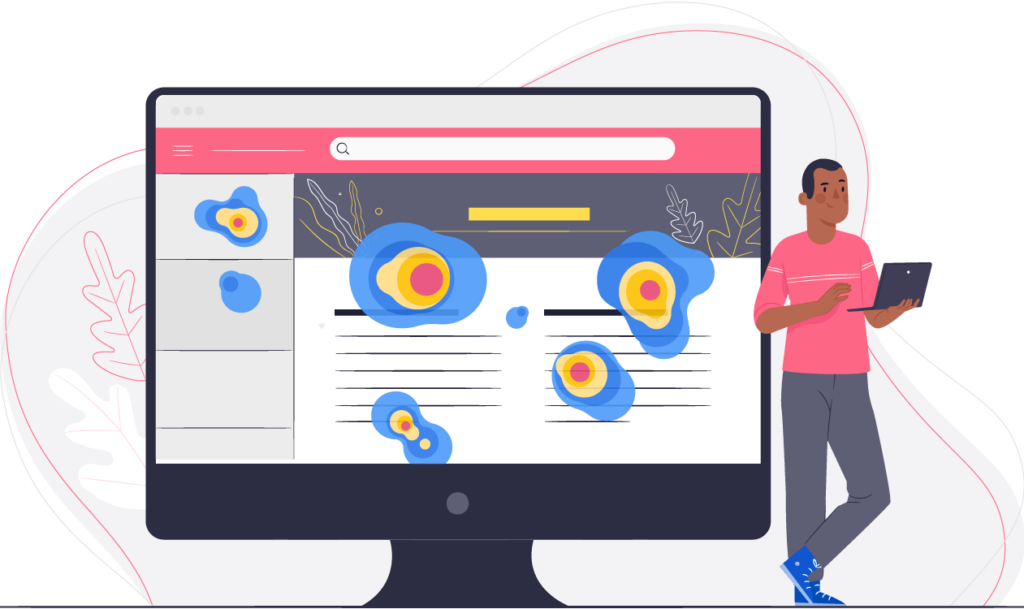
Many teams use a session recording service for this step because watching real sessions builds empathy faster than reading charts. Watch with a question in mind (“where do people stall on the pricing page?”), take notes with timestamps, and count how many sessions show the same behavior before calling it a pattern.
Testing Skills: Turning Ideas into Evidence
An experiment is only as good as its setup. A solid test plan contains the problem observed, the hypothesis (“because visitors cannot see delivery costs, showing them earlier will reduce checkout exits”), one primary metric, guardrail metrics, the audience, the minimum run time and the decision rule. Learn the craft in the CRO testing guide, and keep this list of hygiene rules close:
- Change one meaningful thing per test, or accept that you cannot attribute the result.
- Run tests in full weekly cycles so weekday and weekend behavior are both represented.
- Check for sample ratio mismatch: if a 50/50 split delivers 55/45, something is broken.
- Quality-check every variant on real devices before launch.
- Record every result, including losers, in a shared log.
Prioritizing is part of testing skill. Frameworks such as ICE or PIE score ideas on impact, confidence and effort; the scores are rough but they stop the loudest opinion from winning.
Creative and Persuasion Skills
CRO is not only numbers. Copy, layout and trust signals decide whether a hypothesis is worth testing. Useful habits include writing benefit-led headlines, putting the primary action where the eye lands, removing competing links near it and answering the objection that stops people (price, risk, effort). Browse landing page idea examples to train your eye, then explain to yourself why each element is there.
Psychology principles such as social proof, loss aversion and anchoring are helpful starting points for hypotheses, but they are not guarantees. A principle that worked on one audience can fail on another, which is exactly why testing exists.
Soft Skills That Decide Whether Your Work Gets Used
- Curiosity. The best optimizers keep asking “why did that happen?” after a result arrives.
- Collaboration. Tests need developers, designers, copywriters and analysts. Learn how each works and what they need from you.
- Storytelling with data. Lead with the business question, show one chart, state the decision. Skip the 30-slide deck.
- Patience and humility. Many tests are inconclusive or lose. A culture that rewards learning, not only wins, keeps the program alive.
- Ethics. Persuade without deceiving: no fake scarcity, hidden costs or confusing cancellation flows.
Tools to Know (Categories, Not Brands)
| Category | Used for | Learning tip |
|---|---|---|
| Web analytics | Funnels, segments, acquisition and conversion reports | Build one custom report from scratch |
| Session recording and heatmaps | Seeing behavior and friction | Watch 20 sessions per week |
| A/B testing platform | Splitting traffic and measuring variants | Run an A/A test to learn how noise looks |
| Survey and feedback | Asking visitors why | Keep to one or two questions |
| Page speed tools | Spotting slow pages | Compare lab and field data |
For a wider comparison, see the conversion rate optimization tools overview.
A Six-Month Plan to Build CRO Skills
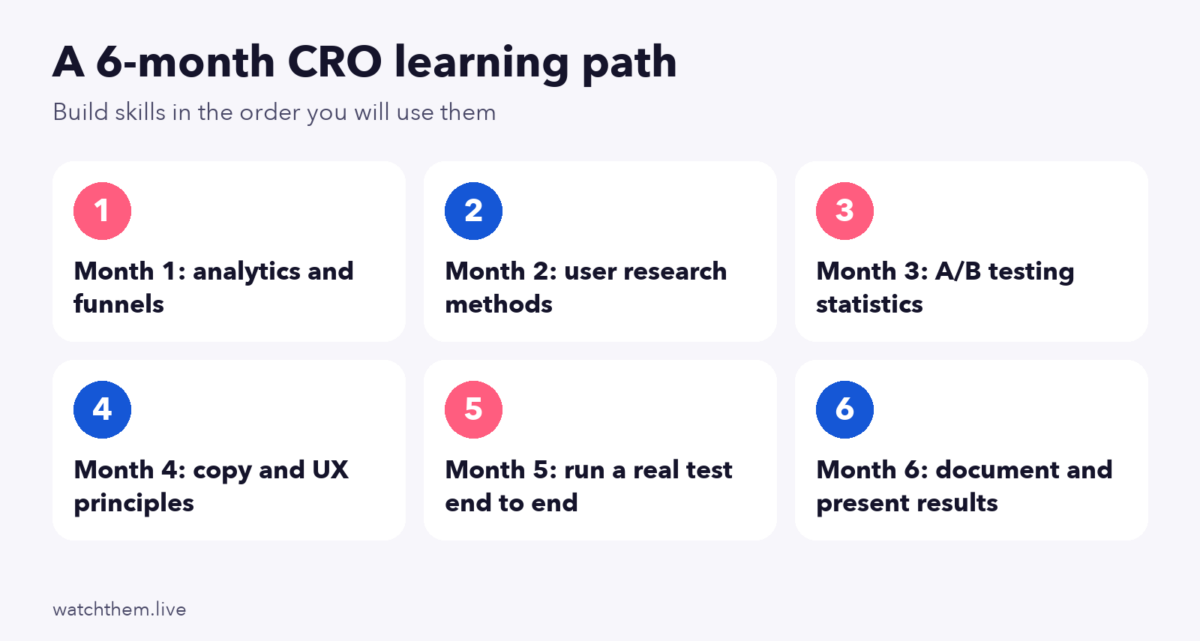
- Month 1, analytics. Learn your analytics tool until you can build a funnel and a segment without a tutorial.
- Month 2, research. Watch recordings, read support tickets, run a two-question survey.
- Month 3, statistics. Study sample size, significance and common testing mistakes.
- Month 4, copy and UX. Rewrite ten headlines and sketch three layout alternatives for one page.
- Month 5, a real test. Run one end-to-end experiment on a low-risk page and document it.
- Month 6, communication. Present the result in one page: problem, hypothesis, result, decision, next step.
Pair this plan with a hands-on conversion rate optimization audit of a site you know well. The audit becomes the first case study in your portfolio.
How to Prove Your CRO Skills
Employers and clients look for evidence more than certificates. A strong portfolio has two or three case studies, each with the problem, the data used, the hypothesis, the test setup, the result with its uncertainty, and what you learned. Include a failed test: it shows honesty and judgment. Numbers should always be framed with context, such as sample size and run time, not as a bare “+30%”.
Interview questions you should be able to answer
- How do you decide what to test first?
- A test shows +12% after four days. What do you do?
- How would you diagnose a sudden drop in conversion rate?
- What do you do when a test is inconclusive?
- How do you handle a stakeholder who insists on their own idea?
Common Mistakes When Building CRO Skills
- Learning tools instead of thinking. Tools change; hypothesis quality does not.
- Copying best practices. A tactic that worked elsewhere is a hypothesis, not a fact. Compare with a CRO best practices checklist and test before adopting.
- Ignoring data quality. Fancy tests on broken tracking waste months.
- Chasing small wins on low traffic. Sites with little traffic should test bigger changes or lean on qualitative research.
- Never presenting. A result nobody understands changes nothing.
Frequently Asked Questions
Do I need to know how to code to work in CRO?
Not necessarily, but basic HTML, CSS and comfort with browser developer tools help you QA variants and talk to developers. Many roles rely on visual testing editors and a developer for complex changes.
Is CRO more art or science?
Both. Research and statistics make it a science; knowing what to test and how to word it is craft. The combination matters more than either half.
How long does it take to become competent?
With regular practice, the six-month plan above gets most people to a solid foundation. Mastery takes years of experiments, including many that fail.
Which skill should I learn first?
Analytics. If you cannot trust or read the data, every other skill rests on guesses.
Can a marketer, designer or developer move into CRO?
Yes. Each brings a head start (copy, UX, technical) and needs to add the missing parts, usually statistics and structured experimentation.
Conclusion
CRO skills fall into four groups: analytics, testing, research and craft, held together by communication. Score yourself with the scorecard, work on the two weakest areas first, run one real experiment and write it up. If you want a reference for the numbers you will meet along the way, start with conversion rate basics explained and keep learning from your own data.
