
Page Contents
Last updated: October 2026
Customers do not experience your website, your support team and your delivery separately. They experience one company. Customer experience optimization is the practice of improving every step of that relationship so that people find it easy, trustworthy and worth coming back to. It goes beyond design and looks at the whole journey: before the sale, during it and after.
This guide explains what customer experience (CX) optimization is, why it matters, five steps to start, how to measure it and how it differs from UX. Where figures come from older or secondary sources, we say so.
What Is Customer Experience Optimization?
Customer experience optimization means using research, data and testing to improve how customers feel and behave across all their interactions with your business: advertising, your website, sales, checkout, delivery, support and loyalty programs. The goal is to remove friction, meet needs earlier and make each moment more helpful.
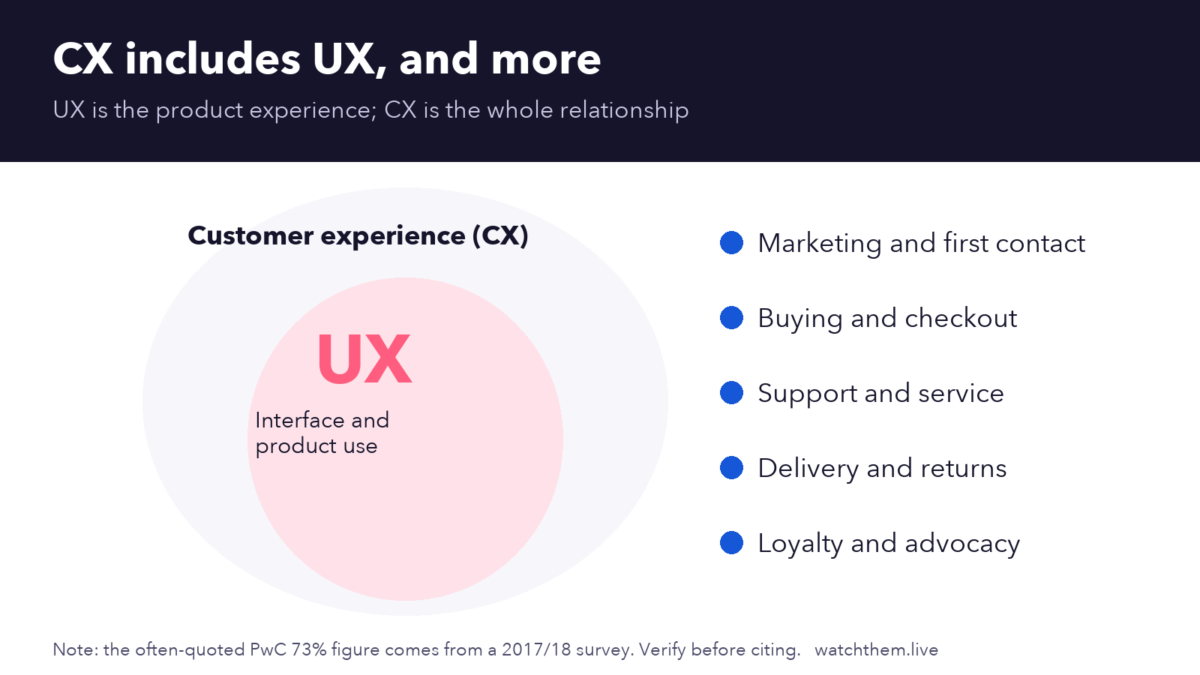
It is closely related to user experience (UX) but broader. UX focuses on how people use a product or interface. CX covers the entire relationship. A beautiful app does not help if delivery is late, and fast delivery does not help if the checkout is confusing. See our comparison of CX vs. UX.
What Is the Importance of Customer Experience Optimization?
- It affects buying decisions. A widely quoted PwC survey reported that 73% of people see customer experience as an important factor in their purchasing decisions, though price and quality still rank first. The survey is from 2017 and 2018 and covered 15,000 people in 12 countries, so treat it as dated context.
- It drives loyalty and repeat purchases. Happy customers come back and recommend you, which lowers acquisition costs.
- It reduces support costs. Clear information and smooth processes prevent problems.
- It improves conversion. Friction at any step costs sales. See conversion rate optimization.
- It differentiates you. When products are similar, the better experience wins.
How to Get Started With Customer Experience Optimization
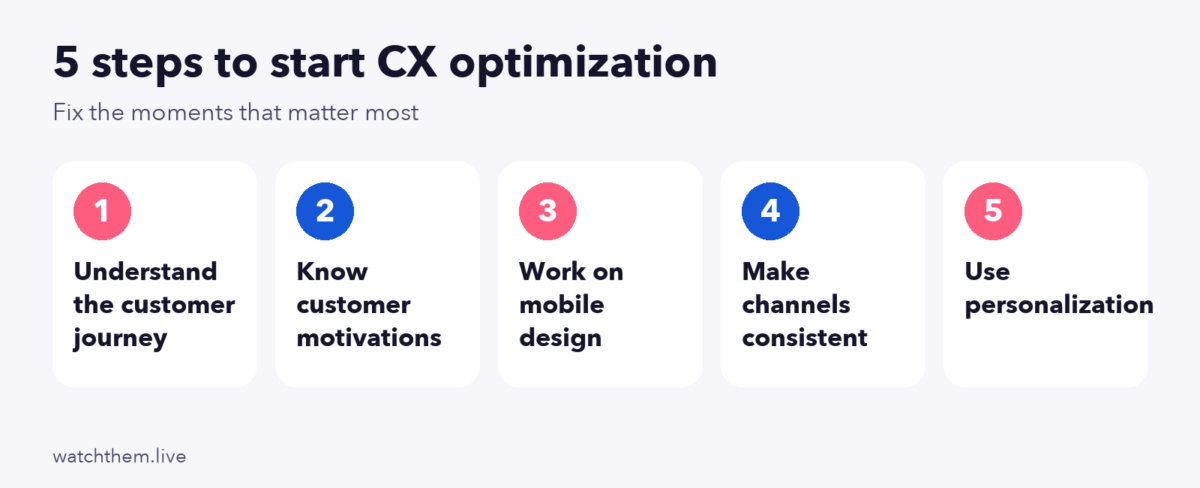
1. Understand Your Customers’ Journey
Map the stages customers go through: discovery, research, purchase, delivery, use, support and renewal. Note the actions, thoughts and feelings at each stage and the channels involved. Use data, not guesses: analytics, interviews and surveys. See buyer journey mapping and customer behavior analytics.
2. Know Your Customers’ Motivations
Find out what people are trying to achieve, what worries them and what makes them choose or leave. Ask open questions, read support tickets and reviews and talk to customers. Build simple personas for your main segments. See persona mapping, psychographic segmentation and consumer psychology.
3. Work on Your Mobile Design
Many journeys start or continue on phones. Mobile is roughly 60% to 63% of global web traffic, according to Statcounter data for 2025, yet mobile visitors usually convert less than desktop visitors. Check key flows on real devices: large tap targets (WCAG 2.2 sets a 24 by 24 CSS pixel minimum), short forms, autofill and fast pages. See mobile CRO.
4. Make the Experience Consistent Across Channels
Customers switch between channels: they see an ad, visit the site, chat with support and buy in a store or app. Make sure the message, prices, tone and information match everywhere, and that context carries over. A customer should not have to repeat their problem each time. Shared data between sales, support and marketing makes this possible.
5. Use Personalization as a Strategy
Relevant experiences feel helpful. A 2021 McKinsey survey reported that about 71% of consumers expected personalized interactions and about 76% were frustrated when they did not get them. The data is dated, but the direction holds. Start with simple steps, such as relevant recommendations and messages tied to behavior, and respect privacy. See website personalization.
How to Measure Customer Experience
Use a mix of attitude and behavior metrics. Our guide to customer experience metrics goes deeper.
- Customer satisfaction (CSAT): a quick rating after an interaction.
- Net Promoter Score (NPS): the percentage of promoters (scores 9 and 10) minus detractors (0 to 6).
- Customer effort: how easy it was to get something done.
- Retention and repeat purchase rate.
- Task success and conversion rate on key journeys. See UX metrics.
- Support volume and resolution time.
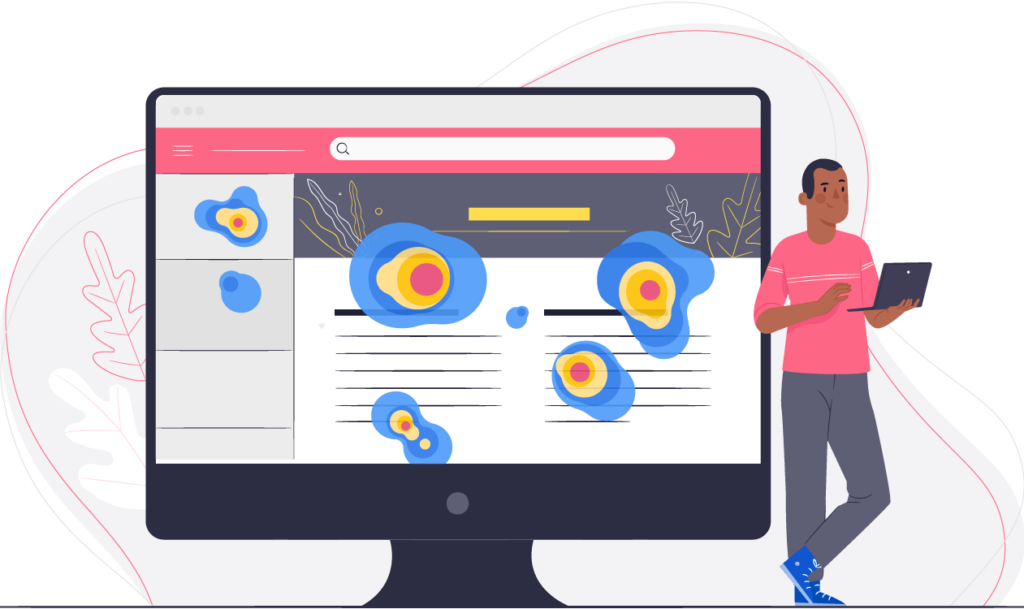
Pair numbers with observation. Session recordings and heatmaps show how customers behave on your site, and conversations show how they feel.
The Best Tools for Customer Experience Optimization
A basic toolkit has four parts:
- Analytics and funnels to see where customers drop off. See funnel analysis.
- Behavior tools such as recordings, heatmaps and goal tracking, which show what customers do on your site. Track individual journeys with user tracking.
- Feedback tools for surveys, reviews and support tickets. See user feedback.
- Customer data and service software, such as a CRM or help desk, to keep a single view of each customer. See customer experience software and customer experience design.
Customer Experience Optimization and Conversion
CX work and conversion work are two sides of one effort. A confusing checkout, a slow page or an unanswered question all hurt the customer’s experience and the conversion rate at the same time. When you optimize CX, track the numbers that connect the two: conversion rate, funnel drop-off, repeat purchases and support contacts. A good routine is to review the funnel each month, watch recordings of the steps with the highest drop-off and read recent support tickets for the same steps. The pattern between them usually points to the best fix. See funnel metrics and conversion rate for the numbers to watch.
Keep ownership clear: someone should be responsible for each journey, with authority to coordinate marketing, product and support. Without an owner, the experience tends to fall into the gaps between teams.
A Simple CX Optimization Process
- Pick one journey that matters, such as first purchase or onboarding.
- Collect data from analytics, recordings, surveys and support.
- Find the biggest pain points, and rank them by impact and effort.
- Fix and test. Make one change at a time and compare results.
- Close the loop. Tell customers when you act on their feedback.
- Repeat for the next journey.
Customer Experience Across the Journey: Quick Wins
- Before the sale: clear pricing, honest product information, helpful content and fast answers to questions. Review your pages with the landing page checklist.
- During the purchase: guest checkout, few fields, total costs shown early and several payment options. Roundups that cite Baymard Institute research put average cart abandonment near 70%, with unexpected costs and forced account creation among the top reasons.
- After the sale: order confirmation, tracking information, easy returns and a short check-in message. This is where loyalty is won or lost.
- Support: visible contact options, live chat that shows agents what the customer was doing, and quick follow-up. See lead conversion for response-time evidence.
- Loyalty: useful emails, rewards that fit your customers and a simple way to give feedback.
Choose one quick win per stage, measure it and then expand. Small, visible improvements build momentum and show the team that CX work pays off.
How to Collect Useful Customer Feedback
Feedback is the raw material of CX work, but poorly collected feedback misleads. A few habits help:
- Ask at the right moment. Short surveys right after a purchase, a support chat or a first use capture fresh opinions.
- Keep it short. One rating and one open question usually beat a long form.
- Read the comments. Scores say how customers feel, but comments explain why.
- Look across sources. Compare surveys, reviews, support tickets and recordings. A problem that appears in several places is real.
- Tell customers what changed. Closing the loop shows that feedback matters and raises response rates.
Remember that surveys reach only some customers. Behavior data, such as drop-off points and repeat purchases, shows what the silent majority does.
Common CX Optimization Mistakes
- Working in silos, so marketing, sales and support each improve only their own step.
- Collecting feedback without acting on it.
- Relying on one metric, such as NPS, without understanding the reasons.
- Ignoring the post-purchase experience, where loyalty is built.
- Over-automating and making it hard to reach a human.
- Treating CX as a one-time project.
Frequently Asked Questions About Customer Experience Optimization
What is customer experience optimization?
It is the continuous process of improving all customer interactions with your business, from first contact to loyalty, using data, research and testing.
What is the difference between CX and UX?
UX focuses on how people use a product or interface. CX covers the whole relationship, including marketing, sales, delivery and support.
How do you measure customer experience?
Use satisfaction scores, NPS, customer effort, retention, task success and support metrics, and combine them with observation.
Where should I start?
Map one important journey, find where customers struggle using data and feedback and fix the biggest pain point first.
How often should I review customer experience?
Check key metrics monthly, review journeys quarterly and run a deeper analysis after major changes.
Conclusion
Customer experience optimization connects the dots between your website, your service and your promises. Understand the journey and motivations, work on mobile, keep channels consistent and use personalization carefully. Measure with both numbers and observation, act on what you learn and repeat. Over time, small improvements at each touchpoint make customers more satisfied, loyal and profitable.
